Author: nickw@beekeeping.co.nz

  • 1925

    In 1925 the Massey Government set up the Export Honey Control Board. While a move toward more orderly marketing, it gave only limited protection when considering that 80% of honey was sold on the local market.

    In the 1925 calendar year the HPA sold 293 tons 7 cwt in bulk and packed 261 tons 6 cwt.

  • 1924

    1924

    In early 1924 an advertisement in The New Zealand Fruitgrower and Apiarist had the apiary of Mr FC Baines, the former editor of the NZ Beekeeper journal, for sale. The advertisement indicated that Mr Baines had taken on secretarial work, preventing him from giving sufficient time to the 100 colonies of 12 frame gear. A letter from Mr Baines in the same issue informed beekeepers that he had resigned as NBA Secretary. Mr HN Goodman was appointed to replace him in the meantime, though by May it appears that Mr TS Winter (on the staff of the HPA) had been chosen as Secretary.

    In March the HPA faced still further management changes with the resignation of Mr H Fraser, who was leaving for England on private business affairs. Mr J Rentoul, a director of the company, was appointed manager for the meantime.

    Another company had been formed, offering to buy special and light amber grades at 1 d per pound more than the HPA was offering.

    The HPA closed their beekeeping supplies department.

    The Annual Conference was held in Christchurch on 5 and 6 June. The NBA was at a low ebb, and the lack of funds for magazine, executive meetings and other activities came into almost all discussion.

    A primary topic was honey export control. The HPA had been the sole exporter over the previous three years. A board of three members, one each from NBA, HPA and the Government, was proposed as a ‘control’ measure to supervise exports and say in what form they should be sent to England.

    Mr AR Bates was re-elected as President. Mr GK Kitchingham (Greymouth) was elected Vice President. Executive members elected were Mr J Rentoul (Auckland), Mr AH Davies (Hamilton), Mr RA Gibb (Menzies Ferry) and Mr CA Pope (Happy Valley).

    The statistics indicated that there were 6,289 apiaries in New Zealand, with 89,600 hives in total.

    In early December voting papers were sent out to beekeepers to decide whether the Honey Control Board would be formed. Altogether, 401 beekeepers were eligible to vote.

  • 1923

    Mr AB Callick was apppointed to replace Mr RW Brickell as manager of the Alliance Box Co, owned by the HPA. Mr Callick had been Mr Brickell’s “right-hand man” in the manufacturing department for the past 20 years.

    The first advance from the HPA for the 1923 season’s honey was set at 4½ d per pound maximum.

    Prices for Californian honey on the London markets continued to fall, causing concern to the HPA Board of Directors. The Californian Honey Producers’ Co-operative Association failed very badly, losing £45,000 for suppliers, due to bad management. The falling prices were affecting New Zealand honey sales as well.

    The HPA Board of Directors sent out a controversial circular letter to shareholders, asking them to dispose of as much honey locally as they possibly could. This was contrary to previous direction, but it was felt that the more that was disposed of locally, the lighter the burden on Mills and Co who were trying to move the backlog of stocks in England.

    The 1923 Conference (the tenth annual) was held in the Oddfellows’ Hall in Palmerston North starting on 20 June. The meeting was presided over by Mr AR Bates, the Vice President. Mr EW Sage, the President, was unable to attend due to “family reasons”.

    In a turnaround, the Conference voted against the Apiaries Tax that had been supported by previous conferences all the way back to 1913.

    Elections resulted in Mr AR Bates (Kaponga) being elected as President with Mr Robert Gibb (Menzies Ferry) as Vice President. Executive were Mr EW Sage (Ohaupo), Mr HN Goodman (Greenfields), Mr TG Clark (Hobsonville) and Mr J Rentoul (Cheviot).

  • 1922

    Mr J Rentoul, Chairman of the HPA, announced the summary dismissal of Mr CF Ryland, the General Manager of the HPA, for “complaints of neglect of correspondence, etc”. It appeared that Mr Ryland had been instructed to buy as little as possible, make all economies possible and be very strict about extending credit.

    Mr Ryland was replaced by Mr Hugh Fraser, previously secretary-accountant to the HPA.

    Mr RA Spindley had been sent to England the previous June, and was still there. He had been the HPA’s auditor, and was also a provincial organiser for the National Party. His initial brief had been to identify a suitable agent to handle New Zealand’s honey, with AJ Mills and Co being suggested as most likely.

    While in London Mr Spindley met up with then Prime Minister, the Rt Hon WF Massey, who was very interested in what efforts beekeepers were making to control the sale of their honey. The meeting was later credited with being the impetus for the Honey Export Control Act in 1924.

    Spindley remained in England for nearly a year, arranging promotional displays and writing articles for food industry trade journals. He was also there to determine firsthand the position regarding the still unsettled claims and counterclaims related to the B & D’s liquidation. While it was not admitted at the time, the losses to producers were ultimately revealed to be about £10,000.

    The Editor described a beekeeper who did not support the HPA or who competed with it while being a shareholder variously as a drone, a cheat, a traitor or a dead-beat!

    Statistics provided in the April issue of the Journal help to put the industry’s growth in hives and honey production, despite a drop in beekeeper numbers, into context.

    Year Beekeepers Hives Honey (lbs)
    1906 15,396 74,341 1,003,940
    1911 11,011 71,605 1,457,429
    1916 8,244 57,540 1,363,334
    1921 8,426 85,861 2,807,346


    In April the HPA announced the purchased of the Alliance Box Co Ltd, previously managed by Mr RW Brickell who remained as manager of the supplies department for the HPA. The continued expansion into beekeeping supplies was seen by the HPA as a way of assisting the profitability of its shareholders. The HPA had received 422 tons of honey to date for the year. Paid up capital was just over £6,000, with about 800 shareholders. Honey exported last year was 878,455 pounds, with 266,348 pounds sold to date.

    In May the Hon W Nosworthy, Minister of Agriculture, announced that the Government would not proceed with the proposed Apiary Registration Fee (as it had become known).

    Mr D Franke announced an improvement of his appliance to extract thick honey. Rather than a single set of nails to stir the honey with, he developed the idea as a set of two semicircular faces from which sets of (steam heated) nails projected. Both sides of the comb were ‘pricked’ at once, with the comb drawn between the faces as the handle was operated.

    The Ninth Annual Conference was held in Dunedin at the YMCA Hall from 31 May to 2 June. The Conference had originally been planned for Christchurch for 7 to 9 June but was changed to meet the wishes of South Island beekeepers. Mr TG Clark was in the chair, replacing Mr TW Kirk.

    Sir William Fraser opened the conference in place of the Prime Minister. The remits considered were for the most part the same that got considered the previous year – the call for a Chief Apiarist, better enforcement of the Apiaries Act and discussion on the Apiaries Tax proposal. By this time the Apiaries Tax had been extended to allow for 20% of the money collected to be used by the NBA.

    As with other conferences of the time a number of papers were delivered on topics of practical beekeeping, beekeeping politics and marketing. Mr Isaac Hopkins as elected a life member of the National by a unanimous and enthusiastic vote. Interestingly, the constitution did not provide for life memberships…

    Mr EW Sage (Ohaupo) was elected President for the coming year, with Mr AR Bates (Kaponga) as Vice President. Executive members were Mr J Rentoul (Cheviot), Mr TE Clark (Hobsonville), Mr R Gibb (Menzies Ferry) and Mr HN Goodman (Clutha Valley). A change to the constitution for the first time made the Secretary-Treasurer a permanent officer, a non-voting member of the Executive to be appointed by the Executive.

    The October 1922 issue of the Journal contained the announcement that it would be the last. In the future the official organ of the NBA was to be the NZ Fruitgrower and Apiarist magazine. All correspondence regarding subscriptions and other industry correspondence was to be directed to the Editor of that magazine. Mr I Hopkins had written for the Apiarist for some years and handled the editorial views with a fairly heavy hand. In selling their magazine, the NBA agreed to not start another one for ten years.

  • 1921

    In an open letter to beekeepers in January, Mr CF Ryland, the General Manager of the HPA, warned that the 1921 crop might provide 1,500,000 pounds of honey above that required for local consumption. He called for continued co-operation and support for the HPA.

    The February issue of the journal announced the voluntary liquidation of the Bristol and Dominions Producers’ Association Ltd. The Editor claimed it would not affect the HPA shareholders much as “practically no honey was forwarded to them last year to enable them to clear up the stocks that had accumulated since the Armistice was declared.”

    Mr CF Ryland for the HPA provided a lengthy statement, saying that he did not expect the liquidation to affected dramatically, with a firm demand for New Zealand honey in England. He did say that a number of shipments had been held up in dock for several months and they had heavy leakage and fermentation. He could not say if there would be loss from those shipments, or whether there would be further realisations collectable from the B & D.

    The 1920 crop had been marketed mostly to New Zealand, the United States and Canada, possible only because of a bad crop there. Seeing the possibility of New Zealand honeys finding such favour there, the Americans and Canadians immediately enforced a 3 cents per pound import duty to stifle the trade.

    By finding these other markets and doing the business on a ‘cash’ basis further loss had been averted. The 1918 and 1919 honey, however, would not be expected to provide any further return to producers above the advances already paid out. Approximately £30,000 of Imperial Bee honey had been sold in New Zealand in 1920, an increase over the previous year of £15,000. The return to beekeeper reached the figure of 7 ¾ d and pro rata.

    The total honey handled in 1920 by the HPA was 500 tons, with turnover of £75,000. Shareholders had increased from 500 to 700, and the subscribed capital had doubled. The beekeeping supplies portion of the HPA grew from £6,000 to £17,000 turnover.

    Within months, beekeepers were recognising that the export market had fallen to pieces, and were trying to address the problem of what to do with all the honey. The local market, over which some control could be exerted, was being wrecked “by foolishness, or we will say selfishness”. With reports that HPA shareholders were selling their crops locally, the Editor commented “So the rot has set in badly!”

    The 1921 Conference was held in Auckland, and beekeepers were welcomed by the venerable Mr Isaac Hopkins (then 85 years of age), President of the Auckland Bee Club, a branch of the National. The Conference was held at the Chamber of Commerce on 8 to 10 June.

    The ‘hardy annuals’ of calling for a Chief Apiarist to be appointed, more inspectors and higher penalties for breaches of the Apiaries Act, and a reaffirmation of support for the Apiaries Tax were topics of discussion. In a practical demonstration, Mr D Franke of Turakina displayed his appliance for extracting thick honey from the combs without breaking. The device was a brush 9 inches by 3½ inches, but with 1½ inch fine nails instead of bristles. The nails were inserted into the cells and ‘stirred’ briefly. The demonstration was successful and impressive to those beekeepers who had “put tons and tons into the river” as being unextractable.

    Mr TW Kirk (Wellington) was elected President. Mr Kirk had been the Director of the Horticulture Division of the Department of Agriculture until his retirement shortly before Conference. It was the first instance when the Vice President had not been elected as the new President – he was nominated by Mr Sage who would have presumed to move into the President’s role. Mr TE Clark (Hobsonville) was elected Vice President. Mr WE Barker (Rangitata), Mr L Irwin (Woodlands), Mr AR Bates (Kaponga) and Mr RS Hutchinson (kerepuhi) were elected to the Executive.

    In October the Poverty Bay branch, with Mr James Adams as Secretary, wrote to the NBA announcing its resignation as a branch of the NBA. The reasons given related to the branch’s opposition to an Apiaries Tax.

    After only six months as NBA President, Mr TW Kirk resigned in December. He had been having “a rocky time for several months” but had withheld the resignation as long as possible. From comments made, it appeared to be a general stress related disease which it had been hoped would have been improved by the resignation from the Department of Agriculture job, but this did not improve matters. The Vice President Mr TE Clark assumed the role.

  • 1920

    The first issue of The New Zealand Beekeepers’ Journal for 1920 brought a substantial change in appearance. The Editor had the journal printed on an improved grade of paper, much whiter in appearance, and would now provide a small photograph on the cover of each issue. The first photo was of his own home apiary in Katikati, Bay of Plenty.

    The subject of apiary boundaries, the proposal that sites should be restricted to avoid overstocking or overcrowding. Mr I Hopkins and Mr James Allan continued their strong opposition to the proposals, with Mr RH Nelson and Mr A Ireland as primary proponents.

    The HPA continued to appeal for support from beekeepers. Advertisement titled “Civil War in New Zealand” and “Outbreak of Hostilities – A Warning to the New Zealand Beekeeper” painted a dire picture of the consequences of failing to support the co-operative movement. The return of speculators to the honey markets in the post-War period was bringing renewed attempts to offer high prices in order to attract producers, with the offers being withdrawn after only a few weeks, according to the HPA.

    Conference in 1920 was held in Christchurch, the first national conference to be held on the South Island. The Conference was held at the Concert Hall of the YMCA, and was held from 9 to 11 June, a return to the three day conferences of years past. Mr W Watson (Geraldine) was elected President, Mr EW Sage (Ohaupo) as Vice President. Executive elected were Mr R McKnight (Domett), Mr AH Davies (Hamilton), Mr AR Bates (Kaponga) and Mr L Irwin (Woodlands). Among other controversial discussions was the proposal to levy beekeepers £1 each in order to fund the provision of more apiary inspectors. The Minister did not favour the proposal, suggesting instead a proportionate tax of £1 for commercial beekeepers and 5/- or 10/- for the small man or those who did not sell honey.

    A controversial advertisement appeared in the July issue of the journal. It purported to offer queen bees from the Isle of Wight for sale! The advertisement stated it was only a matter of time before the Isle of Wight disease (called “Disappearing Trick” in Australia) would reach New Zealand. Stocking hives with bees from strains that had withstood the disease was said to be a means of preparing oneself for the “greatest scourge which has ever struck the industry”. The advertisement was placed by “Schroeder & Schmitt”.

    The next issue of the magazine revealed the Editor had received considerable comment! He had received wires from the President, Executive and the Apiary Instructors! He denied being the person who inserted the advertisement, maintaining it had come from “a member of the National and a valued contributor to the Journal.” In a letter in a later journal, they denied the advertisement was simply a “practical joke” but maintained they had placed the advertisement as “the most forcible and efficient way of bringing to the notice of New Zealand beekeepers the very urgent and vital need of having laws in operation governing the importation of queen bees from infected countries”. Within several months, such legislation was in place!

    The Dominion’s first automatic foundation machinery was installed at the “Acorn” factory for handling wax in continuous sheets or ribbons.

    Mr A Ireland publicly resigned from the National in a letter to the Editor in the September magazine. He cited “studied opposition and discourtesy” from the President (Mr James Allan) when he was presenting the case for apiary boundaries to Conference.

  • 1919

    With the Armistice in late 1918, NZ beekeepers turned once more toward peacetime activities. Elements of sadness continued in the magazine, however, as the influenza epidemic took its toll of the civilian population. The Editor apologised for the lateness of some of his correspondence as he had been placed in charge of a temporary hospital in the Katikati district, while his home had been used as a nurses’ home.

    Discussions on the desirability of apiary boundries continued in the magazine. The call for licensing of beekeepers and/or sites was strong, but there was no concensus on achieving the desired end of stability in the siting of apiaries.

    Mr HW Gilling, Manager of the HPA, wrote to thank beekeepers for their favourable response in the calling up of subscribed but unpaid capital. He commented that with the war over, the honey in store should soon reach England. He remained confident that the prices being obtained would remain near the same for honey supplied.

    The HPA had handled between 450 and 500 tons of honey during the previous year. The number of shareholders had increased to 412. Subscribed capital was up from £4,510 to £6,716, while paid up capital rose from £849 to £3,631. Operations had been moved from Taranaki to centre on Auckland to make handling of honey somewhat easier.

    By late January prices in England had already begun to slide, with honey having dropped from the high of £200 per ton achieved in 1918 down to £100. Rather than an average return of £150 as the Editor had predicted in the January issue, by March he was suggesting a return of only half of that.

    In March Mr J Rentoul, Chairman of Directors for NZHPA announced the replacement of Mr HW Gilling with Mr CF Ryland as Manager of the HPA. Mr Gilling had resigned but was still planning to stand for the Directorate of the company, though he did not eventually decide to do that.

    The Editor of the magazine produced a small booklet titled “Beekeeping for Beginners” which was available to all NBA members and any new members who joined the NBA.

    Mr H Bartlett Bartlett-Miller of Kihikihi continued to provide a two page advertisement for the magazine extolling the virtues of his patented comb reducer. Mr Bartlett-Miller was very outspoken about the advantages and features of his invention, and spared no prose in describing the shortcomings of anyone who disagreed with him!

    Mr C Smedley of Te Awamutu was also a manufacturer of melters, and a series of competing advertisements featured in the magazine over an extended period of time.

    The Sixth NBA Conference was held in Wellington in the Dominion Farmers’ Institute, Featherson Street, starting on 11 June 1919. Mr James Allan (Tasman, Nelson) was elected President with Mr W Watson (Geraldine) as Vice President. Mr R McKnight (Domett), Mr HR Penny (Okaiawa), Mr AH Davies (Claudelands) and Mr JB Adams (Gisborne) were elected to the Executive

    A letter appeared in the August issue of the Journal from Mr Allan R Bates, formerly of Kaponga. Mr Bates had served in the War and appears to have remained in England for the period following, planning to return later in the year. He described cycling out to visit the beekeeping operation at Buckfast Abbey, and he described the operation as “up to date as any that I have ever seen at home”.

    The packaging of honey in petrol tins (used!) for export was finally discontinued by order of Mr TW Kirk, Director of the Horticulture Division. The allowance had been made for the last year or two due to the lack of tin plate, provide that proper lids were fitted to the petrol tins.

    The October issue of the magazine featured a photograph of the NBA President, Mr James Allan. He was first elected President in 1913, the first president under the new constitution. He served as President again in 1914, and as Vice President in 1918, then President again in 1919.

    The Editor carried out an acrimonious exchange with Mr WB Bray late in 1919 in the pages of the magazine. The Editor, having the final word, returned Mr Bray’s 5/- magazine subscription and told him that he, too, was sorry that he had sent in a subscription!

  • 1918


    The first issue of the NZ Beekeepers’ Journal for 1918 provided a change in type size and layout (now using two columns of text). With a reduction in page numbers from 20 to 16, the Editor assured readers there were in fact more than 2 pages more equivalent reading material than the previous journal.

    Two of the honey graders Mr Earp and Mr Jacobsen had received a call to report to military camp in April. The Editor appealed for an extension to June to enable them to grade this year’s honey crop before joining the war effort. As it turned out, Mr Earp did not need the extension – he did not pass the physical.

    Mr AL Luke of Awakeri, Bay of Plenty, described a variety of honey poisoning incidents. He noted that the honey was gathered in the autumn, and the poison appeared to come from unripe honey extracted then.

    In April 1918, Mr HW Gilling found it necessary to resign as Vice President of the NBA. He did this on a matter of principle, as he objected to the NBA’s journal running an advertisement for a company offering to buy honey for export in competition to the HPA with which he was associated closely. At a meeting in July of the HPA he took the new position of general manager of the HPA at a salary of £400.

    High prices for the 1918 crop both locally and for export put pressure on HPA shareholders. Many shareholders were selling for short-term profit outside of their organisation and contrary to their contract with the HPA. There was considerable fluctuations even over short periods of time in the prices obtained for honey. The HPA in June was paying 9d per pound when the honey was shipped. With difficulties getting shipping space, however, producers were receiving the in-store advance of 5 ½ d on light amber honey, with the rest to come when the honey was finally shipped to England.

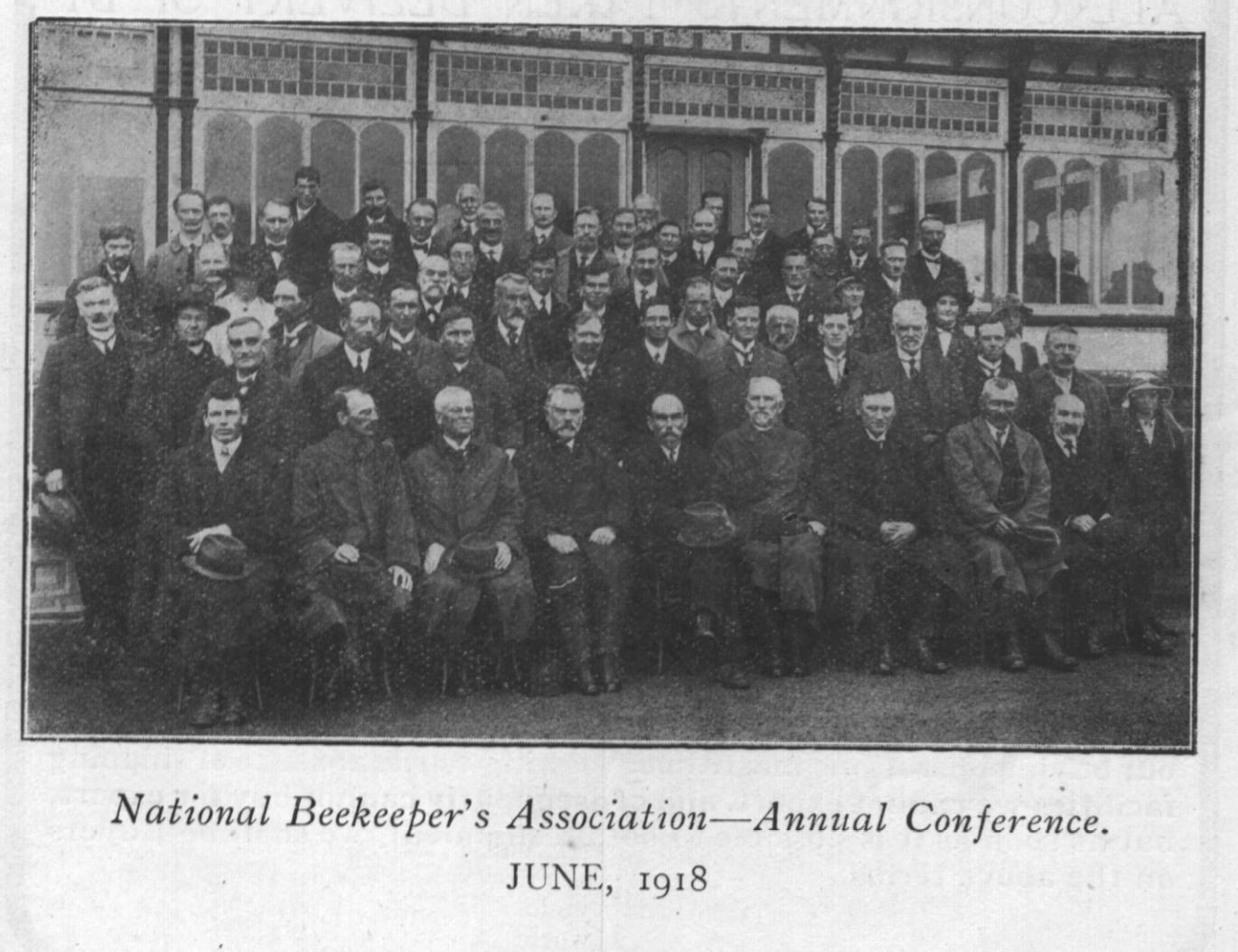
    The Fifth Annual Conference was held on 13 and 14 June 1918 in the Esperanto Hall, Wellington. It was opened by Hon WDS Macdonald, the Minister of Agriculture, and was one of the largest and most enthusiastic held to date. During the Conference a delegation was sent to the Minister to ask for appointment of a Chief Apiarist, a man capable of organising the industry and getting the best results possible from beekeepers, though shortly after Conference the industry was advised that the suggestion was considered “impracticable”.

    WellingtonConf1918

    The Minister also promised his assistance in obtaining shipping space for the 300 tons of honey the HPA had accumulated in shipping stores. He would cable the Prime Minister and Sir Joseph Ward who were in London to point out the advantages of ensuring the honey was shipped promptly.

    Mr WE Barker (Peel Forest) was re-elected as President, with Mr James Allan (Tasman) as Vice President. Executive for the coming year were Mr RH Nelson (Martinborough), Mr EW Sage (Ohaupo), Mr A Ireland (Christchurch) and Mr W Watson (Geraldine). Mr FC Baines remained as Secretary and Editor, and his salary was increased by £26, as well as receiving an immediate £10 bonus!

    In the September issue of the Journal the Editor made some scathing remarks about Mr FA Jacobsen, the apiary instructor for the Wellington district. Mr Jacobsen had failed the physical required for military service and put his name forward to be considered for the position of Chief Apiarist. The Editor felt he was taking unfair advantage over two other contenders for the position who were both serving their country overseas. In the next issue of the Journal, the Editor retracted and corrected many of the statements, upon the advice of Mr Jacobsen’s solicitors!

  • 1917

    Mr WB Bray took over the duties of Editor and Executive Secretary early in 1917. In an editorial in April, he spoke against the practice of tolerating American foulbrood levels in commercial bee businesses, saying “We are inclined to think that the greatest problem the inspectors have to face now is getting the frame-hive beekeeper to give up tinkering with disease and tackle the problem of eradication in a whole-hearted way…The man who has had foul-brood and has eradicated it, not merely kept it down, is the best authority…There are districts that have been cleaned up, and have remained clean so far, and we cannot see why these districts cannot be extended, so that the inspectors gradually have less and less ground to cover.”

    By early 1917 there appeared to be some problems in obtaining shipping space for honey to England, but the B & D continued to receive honey into grade stores to hold until shipping could be obtained. With sugar under control in England honey prices soared, and the HPA payed out as high as 8 1/3 pence per pound late in 1917.

    The HPA was in the process of extending its activities further with the acquisition of a manufacturing plant, the Alliance Box Company’s business in Dunedin. In dividing the profits of the HPA, all profits are pooled. If a trading surplus resulted from such things as was, bees supplies and other lines, it was used to improve the payout for honey. The turnover of the company had increased from £2,000 in 1914, to £6,700, to £8,600 in 1916. It expected the 1917 turnover to reach £12,000. Subscribed capital at the end of 1916 was £3,112, and had been increased to £3,000 by April of 1917, with over 50 new shareholders since the end of 1916.

    By early 1917 the NBA had still not been registered under the Unclassified Societies Act, as the Registrar refused to register the Association. He objected to the reference to Branches in the constitution.

    In March the Journal commented on the fact that the Department of Agriculture had provided one of the apiary instructors with a “five-seater motor car”. The extravagance went against economical grain of the Editor, who commented that a two-seater would have been large enough.

    The Apiaries Division took direct control of the Ruakura Apiary, with a manager appointed to conduct a programme of practical experiments and demonstrations.

    The crop for the year was estimated at 1,250 tons, with a value of £60,000 (at 5d per pound). Prices for export had advanced so that £70 per ton was guaranteed for honey of A grade and light amber B grade. The HPA was advancing 4 3/4 d per pound on those two grades.

    The fourth Annual General Meeting of the NBA and the Annual Conference of the beekeepers of the Dominion was opened in Edmanson’s Hall In Wellington on 6 June 1917, with Mr J Rentoul in the chair. Mr WB Bray, the Secretary, had been called up to military camp just a week before Conference, and had not been able to complete all the arrangements for the meetings. The Secretary of the Department of Agriculture Mr FS Pope opened the proceedings.

    Mr J Allen of Southland proposed a change to the export regulations to allow for the export of granulated honey in boxes similar to butter. He had been using white pine and kauri boxes for six years for the Dunedin market and had found them to be equal in quality but cheaper than tin. The box would hold 64 pounds of honey, and it was suggested that the honey could be cut into ‘pats’ and sold wrapped in parchment as Mr Allen was doing for his markets.

    Once again Conference called for the registration of apiaries to be brought into force. A delegation of beekeepers to the Director of Horticulture on the last day of Conference reported that he felt favourable to the idea and proposed to require bees to be registered by July 31 and every three years thereafter.

    The Government provided a pound for pound subsidy to the Association for subscriptions paid by members, resulting in total income for the year of £290 18 6.

    Elections resulted in a new NBA President following the retirement of Mr Rentoul, Mr WE Barker (Rangitata), with Mr HW Gilling (Hawera) elected as Vice President. Executive members were Mr RH Nelson (Martinborough) Mr EW Sage (Ohaupo), Mr J Rentoul (Cheviot) and Mr RW Brickell (Dunedin). Mr FC Baines (Katikati) became Secretary/Treasurer and Editor of the magazine.

    At the conclusion of the war the stocks where shipped to England (Avonsmouth, the modernised port in Bristol promoted by the B and D). In the meantime, however, the sales of (cheaper) Australian and Californiana honey and corn syrup and the like had created a consumer resistance. This combined with a reduced buying power immediately after the war to create an unanticipated situation. Some of the NZ honey in store had fermentation problems, as well, later blamed on tiny splits at the corners in the tops of the tins being used.

    The Bristol and Dominion Producers’ Association Ltd went into liquidation, still holding considerable stocks of Association honey. The HPA then had two season’s honey in stock and an overseas market with low consumption due to poor quality honey put on the market during the war, stocks of which were still held by the retailers at prices around 3/6 per pound.
  • 1916

    Mr Cottrell, the NBA President, was not able to preside at the 1916 conference due to the necessity for a major operation. The Vice President Mr J Rentoul was in the chair in his place. One resolution called for the Department of Agriculture to enforce the registration of apiaries. The required legislation had been passed seven years before but no action had been taken in the interim. Another resolution of conference called for the registration of the Association under the Unclassified Societies’ Act and the adoption of a uniform constitution throughout the branches.

    Mr J Rentoul was elected as President for the next year at the conclusion of conference, with Mr WE Barker as Vice President. Executive members were Mr HR Penney, Mr EW Sage, Mr A Ireland and Mr WB Bray. Mr RW Brickell remained as secretary, in spite of advertisements for the position that had appeared in previous magazines.

    Almost every issue of the magazine described methods of ‘curing’ American foulbrood. Transferring to foundation, removing the queen, cutting out infected cells, the McEvoy, Clayton, Cotterell, Hobbs and Baldridge methods – all variations had their adherents. It is clear that foulbrood was still causing major problems to the industry, even with the reduction in the number of box hives.

    In September Mr AB Trythall was placed in charge of the apiary at Ruakura Farm of Instruction. Over the next few years over 200 cadets received tuition in commerical beekeeping, including 108 returned soldiers, 20 returned nurses, 15 male civilians and 69 female civilians.

    By the end of 1916 the HPA had several hundred shareholders. Honey exports to the B & D, however, fell 30 tons short of the required 100 ton minimum. Major Norton of the B & D expressed concern, but the company did not take action under the contract that it was entitled to (purchasing a quantity of honey equal to the shortage or recovering damages from the HPA). Major Norton had experienced increased costs and difficulty of obtaining glass containers for packing. In an innovative move, he substituted cardboard containers, which became preferred once the public became used to them.

    Both light and dark honeys were accepted by the B & D for sale in England, with all grades realising similar prices. The lighter coloured honey was sold in the southern cities. The darker honey was sold in the north as New Zealand heather honey until the Agricultural Department stepped in to announce that there is no heather in the Dominion! “What harm could it do anyone when we call the honey obtained from the native weeds heathers, flaxes, and manukas, &c., heather honey?” the Editor of the magazine argued.

    In late 1916 Mr WB Bray wrote an article for the magazine asking for ‘Co-operation’. With a small crop the previous season, he analysed, if all the honey had been sent to England the local market prices would have soared. This would have resulted in a windfall for the non-HPA members and worked against longer term market stability. He urged HPA members who received word of high local prices being offered to turn the offer over to the HPA to supply rather than filling it individually. He concluded the article “We want to ride in a motor car too some day.”

    In November 1916 the Association Secretary Mr RW Brickell found it necessary to hand in his resignation as secretary owing to an early departure from the Dominion on business. A new secretary was to be appointed before the end of the year, with the position advertised at £25 per year.