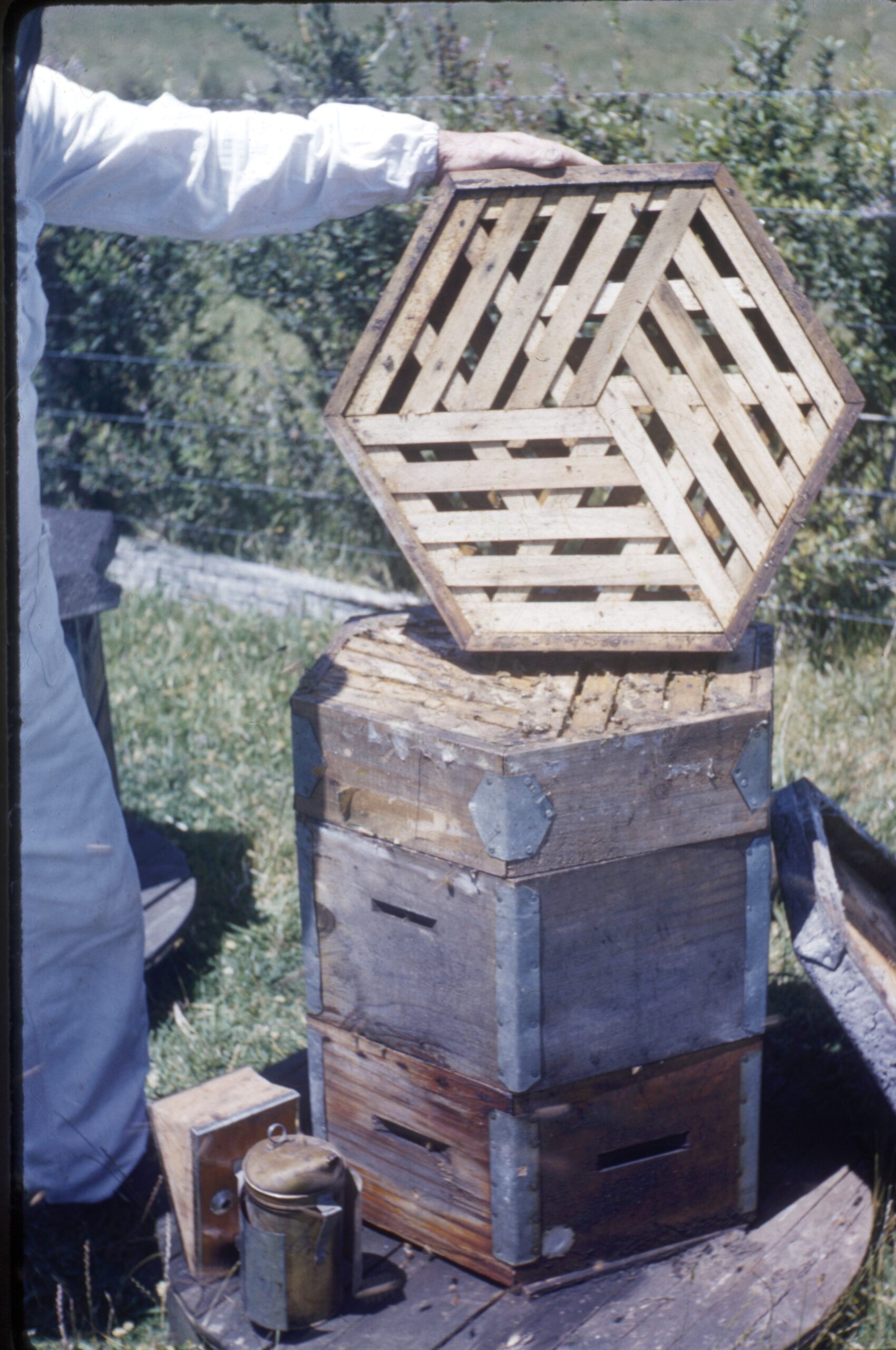
As servicemen returned from overseas and existing beekeepers began to increase hive numbers again, interest turned to the cost of establishing hives. Mr CR Paterson, Apiary Instructor at Hamilton, provided figures to set up 100 colonies of bees. Including the costs of the nucleus units to stock them with bees and 10 pounds of sugar for each unit, he worked out the cost at £412/6/8 for the 100 four storey hives. He calculated a total of 315 hours to assemble, paint and fit foundation. Allowing 2/6 per hour for labour costs he came to a total of £39/7/6. The total establishment costs for 100 hives would be £451/14/2 or approximately £4/10/6 per colony.
Branches had been reviewing the recommendations to change the Constitution put forward by the Executive. In order to accommodate the feelings of the few branches that still had problems with the proposal, Executive modified the amendments to the Constitution somewhat. The previous maximum levy payable level of 600 hives was reduced to 450, and the rate per hive was reduced from 3d to 2d. The minimum subscription was set at 5d. A last proposal was in response to the potential breakaway organisation proposed by South Auckand and Waikato beekeepers – that on matters pertaining to marketing at Conference a vote be taken by commercial producers only. The feelings of some Executive members was given with the notation that “Conference to decide what status constitutes ‘Commercial Producer’.”
By April of 1945 it was clear that the season’s honey crop was far below that of an average season. Crops varied from nil to well under half a normal crop. It was particularly unfortunate at a time when honey was in such deman as a food for war-time requirements. Both the Honey Control Board and the Executive had been presenting a joint case for an increase in payout. The application was to cover, retrospectively, all honey supplied to the IMD during the previous season (1943-44).
In the April, 1945, issue of the magazine was the first advertisement from a new queen and nucleus colony producer. Arataki Apiaries (the “Home of Better Bees”) offers a variety of nucs and queens for sale, with delivery from 1st September.
Mr WB Bray, Leeston, vocal opponent of the compulsory acquisition marketing efforts informed branches that the Paper Controller had denied him the paper he needed to print a booklet to “answer to the misleading propaganda which Branches have been subjected to in recent years”. He offered to attend as many branch meetings as he could to answer “those who would plan the industry into a straight-jacket.”
Mr CR Paterson, Apiary Instructor, showed a German wasp nest that had been dug from the ground in Hamilton at a Whakatane branch meeting at the end of May, 1945. This was the first mention to beekeepers of the German wasp introduction that would eventually require changes to beekeeping practices.
The July 1945 conference was held in Christchurch, and was memorable to all who attended due to a fall of seven inches of snow just before conference concluded! It was the best attended conference in recent years with representatives of almost every beekeeping area in the Dominion. It resulted in an emphatic vote against any further measure of control in marketing policy, except for certain essential requirements during the war period. The re-election of all the members of the previous Executive (unopposed) was further evidence that the producers wanted a policy of voluntary co-operation to be carried out.
The Executive’s proposal involved an estimated crop of 3,000 tons. The 1,000 tons supplied to the IMD appeared to be the amount that beekeepers found unprofitable to market on their own account. The market would normally exist for about 2,000 tons at little distributive or administrative cost. Approximately one half of that 2,000 tons would be sold direct to the consumer (and thus not require a seal affixed). The other half of the 2,000 tons would be sold through the wholesale and retail trade and should bear a seal stamp of ½ d per pound. That would provided just under £5,000 per year to the Seals Fund. That amount would enable a payment on the 1,000 tons supplied to the IMD to allow for a payment ½ d per pound greater than has been paid before for bulk honey. A price of 8 d per pound would be sufficient inducement to secure the 1,000 tons required.
Following conference about 20 visitors hired a bus to visit Mr Tom Penrose’s apiary in Leeston, with the 25 mile trip with snow as far as the eye could see. A well known Waikato producer made the comment that Canterbury producers had easy and immediate personal contact with their market in Christchurch, with the crop being produced just on the edge of the city. Mr Penrose’s operation consisted of 300 hives at this time.
Mr Honeyfield, the Manager of the Auckland depot of the IMD, gave conference a full history of honey marketing in New Zealand. He called for support for IMD to allow it to have
a sound and continuous export policy maintaining the identity of NZ honey in 1 pound containers using the Imperial Bee brand
adequate reserves of stock to maintain markets even in a poor production year
a fixed price to establish the market level for local sales to avoid price-cutting
three standard brands of honey from the Honey Section of the IMD for local sales
advertising as required within New Zealand to stimulate honey consumption trends
a continuous supply of not less than 1,000 tons per year for the Auckland blending and storage plant
the supply of 60% to 70% of the total crop.
On a more mundane note, the Editor announced that the four issues of volume 8, the 1946 year of the NZ Beekeeper, would appear in the months of February, May, August and November. These months of publication continued for nearly 50 years after this change!
At some point after conference, the Minister of Marketing Hon B Roberts announced that “It will not be necessary to continue the Honey Marketing Regulations next season”. The return to voluntary marketing of honey without a ‘commandeering’ of a percentage of the crop had been desired by beekeepers, along with an increase in the bulk price for honey. Two further points of the NBA marketing plan – control of retail prices and the election of a producers’ Marketing Council – remained unresolved. With the announcement coming in the September/October period of 1945, the editorial was scathing in condemnation of the Government’s procrastination.
A letter from Mr WT Herron (Waikaka) called for the reserves of the IMD to be immediately paid out to producers. Seals levy collected during the war period should also be paid out during that period as well, to benefit those who paid the levy.
The “Personal” column of the October 1945 issue contained a range of items. An obituary for Mr RJH Nicholas (Hawera) was printed, describing Mr Nicholas as one of New Zealand’s pioneer beekeepers and one of the original directors of the Honey Producers Association. Along with his brother Mr HB Nicholas he was one of the first beekeepers to make a “really good foundation comb.”
Mr WH Ashcroft (Havelock North) also featured in an obituary. Though Mr Ashcroft was not a commercial beekeeper, his son Mr WJC Ashcroft was running an extensive beekeeping operation from Havelock North.
On a happier note was the announcement of the marriage of Mr A Mawhinney (Te Kawa) to Miss DM Dalgleish (Hastings). Both were well-known correspondents to the magazine in previous issues. The Editor noted the marriage was “An aftermath of Conference. We shall have to ask our President, Mr Field, to keep a tighter rein on members next year.”
Also noted was the birth of a daughter to Mr and Mrs WJ Lennon (Omakau) Executive member and Editor of the magazine. He added, as an editor’s note, that if the Journal was late “blame Sally”, the newborn daughter.
Mr WB Bray’s “An Examination of Honey Marketing Problems” was reviewed in the magazine. Describing the early period of honey marketing, the review said “Many readers today know it by hearsay. Mr Bray lived through the period and the story has the freshness of one with a good memory.” In the foreword to the self-published booklet, Mr WB Bray said “If it appears that the personal pronoun has been used too often, my excuse is that it is inevitable. I have taken an active part and have expressed my individuality without fear.”
A competition was announced for the next issue of the magazine. It called for suggestions for a plan for the NZ honey industry for the post war period, given that the current regulations would lapse six months after the war. While no prize was to be provided, the “honour and glory of contributing something constructive” was used to encourage entries.
In the January issue obituary was printed for Mr WM Sage, 25 years of age, who died while on active service. He was the son of Mr Ernie Sage of Ohaupo, and had been in the honey business with his father and brother.
In a letter to the Editor, Mr TF Penrose, a member of the executive and an opponent of co-operative marketing, wrote to disapprove of the special marketing issue of the magazine. He felt that such “propaganda” should have gone out without being “camouflaged by our cover”.
In early 1944 the Executive met the Minister of Marketing and his advisors to discuss the price of honey and the formation of an Advisory Committee. The Executive put the case for an increase of 1.67d per pound, which the Minister found unacceptable. The Executive found the Minister’s proposal for two members to join an Advisory Committee was not acceptable while the present Honey Control Board continued its functions.
Proposed changes to the Association Conference aimed to give voting right more in proportion to one’s stake in the industry. The moves would place a 600 hive maximum, at 3d per hive, on subscription and voting entitlement. Hive holdings would be dealt with in 30 hive multiples, with maximum voting and subscription being “capped” at 20 votes and £7/10/-. While the proposal was only for branch consideration, the Executive asked that the principle of “one group of hives one payment and one group of hives one vote” be adhered to. The proposal was designed to make £590 available to the Executive to run the Association.
The opposition to the regulated marketing of honey had established itself clearly enough that it was sometimes being referred to as “the Canterbury viewpoint”. While Mr WB Bray, President of the Canterbury branch, made the views quite clear in many meetings, he was not alone in his opposition. Mr RE Hansen of “Beeville” (Taupiri), Mr Alexander Mawhinney (Te Kawa), (Miss?) MA Shepherd (Rangiora) and Mr WJC Ashcroft (Havelock North) all openly criticised the marketing regulations in the pages of the journal.
With the July 20, 1994, issue of the magazine came an important announcement – the NBA annual conference was postponed. A general application for permits to travel was refused by the Minister of Railways on the grounds that he was unable to grant further permits to any organisation. Rather than appear to defy the Government and risk an inequitable attendance from the membership (permits to travel were able to be obtained by some individual members, but not by the organisation as a whole) the Executive made the decision to postpone the conference.
The Executive did manage to hold a meeting in Wellington on 5, 6 and 7 July, 1944. This meeting coincided with a delegation from the South Auckland Branch (Mr Holt and Mr Barber) who had placed production cost figures before the Honey Control Board. The delegation had also take the opportunity to meeting with the Minister to press for the early consideration of the registration of apiaries proposal. Mr Holt made some strong criticisms of the executive, saying he didn’t think they were doing their job.
The Executive met with the Internal Marketing Division (Mr Rentoul, Manager of the Honey Section, and and Mr HF Stoupe, Assistant Manager of the Honey Section) as well as the Honey Control Board (Mr Nelson, Mr Penny and Mr Robins). In the course of these talks Mr Nelson proposed that as the seals fund now stood at £17,013 he felt that the future seals levy should be paid out to suppliers of the Division. The immediate goal was that the Internal Marketing Division’s need for 500 tons for the war requirements and a further 500 tons to supply honey for citizens in the city areas. This amount would allow the IMD to both meet the demands and also maintain its existence as an economic unit. The IMD had received about 1,200 tons in the previous season. As beekeepers were supposed to be supplying 70% of their crop, it was clear that many beekeepers had not complied.
Mr Nelson, when questioned about how this could be achieved, put forward an idea originally proposed by Mr Stoupe. Rather than commandeer 70% of the total crop, he calculated that 30 or 35 pounds of honey per hive, or approximately 50% of the crop, should be sufficient to meet the IMD’s requirements. This idea had the support of both the IMD and the Honey Control Board, and the Executive eventually adopted a variation as a preferred option for the coming season.
The Executive felt that 30 pounds per hive should be commandeered during the war period from beekeepers with 20 hives or more. Should there be a crop failure, beekeepers would be allowed to retain a minimum of 10 pounds per hive.
Following a meeting with the Minister Hon B Roberts, the Executive also agreed to support a Honey Marketing Council consisting of five elected representatives of producers, the Manager of the Honey Section of the IMD, a representative of the Department of Agriculture and the Director of the IMD as Chairman. The previous opposition to this advisory body was primary related to the desire for the beekeepers’ representatives to be elected rather than appointed. In an early expression of the industry’s attitude to equity in voting, the Executive said the voting should be “with a proportional vote limited to one vote on a minimum basis, to a maximum of ten votes on the level of production that provides the producer with a living.”
The retirement of Mr Rentoul from his position as Manager of the Honey Section of the IMD was announced in July, though it was indicated his serviceswould still be available to the division for the next 12 months. Mr Rentoul had had a 30 year association with the marketing of honey. He was one of the directors of the 1914 Honey Producers’ Association, becoming Chairman in 1916 and holding the position until 1924. In 1924 he was appointed Manager of the HPA. He was also elected as the producer’s representative on the Honey Control Board at its inception and was appointed chairman. In 1933 he resigned from the Honey Control Board to become join manager of the Board and of the NZ Honey Ltd, the company formed after the liquidation of the HPA. When the Government took over NZ Honey Ltd in 1938 Mr Rentoul was appointed manager.
Several members of the NBA Executive were also involved in local body politics. Mr E Field, Dominion President, was a Borough Councillor of Foxton. Mr E Kirk, Executive member, was on the Wanganui Harbour Board. Mr L Robins, member of the Honey Control Board, was also the Mayor of Temuka.
The licensing of apiary sites remained a topic of interest. With the expected return of servicemen after the war beekeepers were keen to ensure that there was a regulatory framework to restrict unfair encroachment on existing production sites. The Government had taken no action on the issue during the previous years and the Executive was under considerable pressure to get the regulations into place. In late September 1944 the Minister of Agriculture Mr B Roberts wrote to the Association saying that he did not feel there was enough agreement within the industry for the proposal to go further at that time.
In some personal notes in the October 1944 issue of the magazine was the note that the second son of Mr E Sage (Ohaupo) was missing in air operations.
Mr WB Bray, President of the Canterbury Branch, had spoken at a beekeepers’ meeting in Hamilton to say he felt the NBA was “falling to pieces”. He felt there some was some possibility of a new organisation being formed in opposition and that it was unlikely the NBA would ever hold another conference. Mr EA Field, Dominion President, replied that membership had increased substantially during the last three years, and felt the Association still had the support of beekeepers.
In a report from the Department of Agriculture it was announced that research work would commence on various problems confronting apiarists. The officer chosen to carry out the diagnostic and research work was Mr T Palmer-Jones, B Sc. Mr Palmer-Jones had field experience as a beekeeper before joining the staff at Wallaceville before the war.
In late 1944, Mr IW Forster was appointed as an Apiary Instructor in charge of the Invercargill-Dunedin district, replacing Mr LI Box who had resigned. Mr Forster had trained for two years with “one of New Zealand’s largest beekeepers” and had altogether twenty years practical commercial experience.
The first issue of the 1943 NZ Beekeeper announced the new Honey Marketing Regulations and the Government’s policy on stabilisation of prices, costs, salaries and wages. Beekeepers were keenly aware of increased costs and frozen returns, pinning hope on the “illusory bigger honey crop”.
The price of farm products, including honey, were to be held, along with the major items of a farmer’s costs. The internal prices were to be divorced from export parity and any excess to be paid into pool accounts. Costs of the basic items related to production would also be frozen, but the costs of holding them would be debited to the “appropriate accounts”. The Editor questioned this sort of a move in the honey industry. He felt it unlikely a pool account would be built up from higher export prices, even if honey were to be exported. Where, indeed, would the “appropriate account” be held to which the added costs will be debited?
With the cost increases experienced over the previous two years the Editor felt that 7d per pound pro rata would still be too low on present costs. He called for a bonus payment to producers which would allow for price stabilisation and allow for maintenance or even increase in production.
The Marketing Scheme announced in the previous December called for the supply of 70% of the crop of all beekeepers with 20 hives or more to the Internal Marketing Division. While the remaining 30% could be disposed of as the beekeeper desired, the scheme reserved the right to restrict this if conditions indicated it was necessary. The facilities of existing producer/packers would be utilised for packing to allow for all-the-year-round work for these businesses.
During the previous season, the Marketing Division had had no honey with which to supply the 500 tons allocation to Great Britain, and the amount available for essential war services was over 1,200 tons short of requirements.
This scheme went even further than those proposed previously by the NBA. At the previous conference, a resolution was passed (by a small majority) asking the Marketing Division to acquire 50% of the crop. Some months before that the Government had announced the principle of the zoning scheme, which would allow for restricted private honey sales, but it proceeded no further than the announcement.
Those beekeepers read these editorial and reported stories in the first few pages of the magazine would have been somewhat confused when they got to the letters page. Mr WJ Lennon wrote to thank Mr Field and the executive of the NBA for asking him to become the second editor of the magazine. He conveyed gratitude to Mr Kirker for the work in initially establishing the journal, and the work in selecting material and compiling a new mailing list to make the work of the new editor as easy as possible.
The next story provided the missing link – the announcement of Mr Gilbert Kirker’s death. Mr Kirker had resigned his positions as General Secretary and Editor on 1 October 1942 to enter the Army. He had had an accident to his back during the winter, and found it impossible to carry on with his beekeeping. As he was no longer exempt from military service, he expected to be called into camp during November. While the date of his death was not provided, a circular to branches was included in the magazine announcing the changes to General Secretary and Editor was dated 28 November 1942.
Members were notified to address all material to the new General Secretary Mr GV (Garnie) Fraser in Foxton, and for the Editor to Mr WJ Lennon of Omakau, Central Otago.
At the previous conference there was an amendment to the Constitution to allow for Life Honorary Members to be elected as a “mark of esteem and in recognition of noteworthy service to the industry or the Association”, providing for no fees, no votes and no benefits from the No. 2 Trust Fund (the NBA sponsored insurance fund).
Following the announcement that the IMD would compulsorily acquire 70% of each beekeeper’s crop, the Canterbury Association met in Timaru on 13 March. A resolution to “flatly refuse” to supply until a “satisfactory reply” was received to their representations was passed at that meeting. The meeting reiterated a continued opposition to controlled marketing, and asked that they be exempted from the 1942 regulations.
The editorial for the April issue, only Mr Lennon’s second, played a line straight down the middle, and was titled “Direct Action – Pros and Cons”. He said that the Canterbury action was at least honest and clear, and brought the issue of basic price for honey to the Government’s attention. He did not full support the direct action, however, as he felt the increase should come as the arbitrated decision of members of the community working in co-operation.
Many Association meetings had passed favourable resolutions to the marketing regulations early in the season when prospects for a good season were bring. With a poor crop, many then felt the need for a reconsideration of the basic price paid under the regulations. When the figures of a 10 ton crop from 300 hives, considered the minimum numbers for a commercial apiarist, were used in calculations, the Editor estimated a loss of 1.95d per pound to the beekeeper, a reduction of £182. With the small crops experienced in the last few seasons, the Editor felt the fundamental problem for honey production was simply that honey producers did not receive enough for their labour.
The Dominion President Mr EA Field wrote that though the acquisition of 70% of the crop was more than the 50% supported by the industry at the last conference, he felt that all beekeepers should send their full quota of honey to the Internal Marketing Division. He noted that the effective income of beekeepers was reduced by the acquisition, and agreed that some extra payment should be made to offset the increased cost of production. Ultimately, however, he found it “regretable” that beekeepers had taken an “unconstitutional” action and made incorrect statements to the press about the price paid by the IMD.
The same topic was described in the Internal Marketing Division (Honey Section) report in the April 20, 1943, issue of the magazine. The report concluded that from 1914 until the late 1930s, except for the short interval between the two main honey marketing associations (the Honey Producers’ Co-op and the NZ Honey Ltd), the price of honey had not depended on size of crop or individual ability to master the market. It had depended entirely on some organisation which took the surplus honey off the local market and obtained a good price on a market built up overseas, often after considerable effort.
A poor production year had no effect on prices as there was always a surplus of honey over local requirements. But export of the surplus alone was not sufficient to stabilise local prices, as was shown when low advance payments were made by the marketing organisations. The advance payments tended to set the local price.
Some individual beekeepers argued that they would be capable of selling to better advantage themselves rather than through an organisation. The collapse in prices before NZ Honey Ltd came into being in the early 1930s was used to counter this claim.
The development of the war had resulted in new conditions. A shortage and control of other sweetstuffs had resulted in an unprecedented demand for honey. While consumption previously had been about 3 pounds per year, the demand had increased considerably, especially for purchases in larger quantities. To ensure reasonable supplies for essential services and some for the general populace, a partial control had to be taken.
To justify a claim for higher prices, the IMD believed the costs of production prior to September, 1939, should be compared with the costs of production in 1942, based on the average crop over, say, five years. These production costs should then be accompanied by the selling prices over the same period.
Prices paid to producers for the last 8 seasons were included in the report. During the period of NZ Honey Ltd honey for export was handled and paid for by the Honey Control Board. A large portion of the honey exported by the Board was supplied by NZ Honey Ltd who collected the Board’s payment and used this in its payments to its own suppliers:
1934
NZ Honey Ltd
5d
NZ Honey Control Board
6 1/4d
1935
NZ Honey Ltd
5 1/2d
NZ Honey Control Board
6d
1936
NZ Honey Ltd
5.35d
NZ Honey Control Board
6 1/2d
1937
NZ Honey Ltd
6d
NZ Honey Control Board
5d
1938
Internal Marketing Division
6 1/4d
1939
Internal Marketing Division
6 3/4d
1940
Internal Marketing Division
7 1/4d
1941
Internal Marketing Division
7 1/4d
1942
Internal Marketing Division
7 1/4d
The report noted that the IMDs return to beekeepers was for both local and export, while the previous Board’s payout was for export only. While paying 7 d pro rata for the honey, the IMD was selling it at 7 3/4 d per pound. Honey in 1 oiund cartons is retailed at 1/2 per pound and between the 7d paid and this 1/2 sales price are costs of packing material, labour, distribution costs and wholesale and retails charges.
The figures were provided as publicity out of the Canterbury branch had indicated that the beekeeper was being paid only 5 1/2 d, and the honey was being sold by the IMD for 1/2 per pound. Mr FD Holt, President of the South Auckland Branch (which claimed to produce about one-third of New Zealand’s honey!) wrote to support the IMD and criticise the actions of the Canterbury beekeepers.
After these pages of argument and counter-argument, the Editor wished for a more articles on beekeeping subjects in the magazine – “Other controversial matter seems to require too much space.”
A report from the Manawatu branch reported that Mr JW Walworth’s honey extraction plant, 6 tons of honey and a two-ton truck were destroyed in a fire, with damage estimated at £1,200.
The Annual Conference was held in the Chamber of Commerce Hall of the Dominion Building in Wellington. It ran for three days from 30 June to 2 July 1943. In opening the conference Mr Barclay, the Minister of Agriculture and Marketing, said it was the first Dominion Conference he had had the pleasure of attending.
The total estimated crop from commercial apiaries was estimated at 2,605 tons. Shortage of labour, with sons and employees joining the armed forces, had reduced the average number of hives operated by many large commercial beekeepers. At 30 June 1942, there were 7,996 apiaries, containing 132,136 hives. On 30 June 1943 there were 8,407 apiaries with 133,604 hives. As there had been an increase in the number of beekeepers, the industry was aware that the post-war period might present disease control problems, as many of these new beekeepers had but scant knowledge of the requirements of the industry.
A month later, in August 1943, beeswax came under the control of the Ministry of Supply. “First use” for beeswax was for bee comb foundations, but beekeepers were required to furnish returns to the Factory Controller of any stocks (over 10 pounds) held. At the same time, the price controlled by the Price Tribunal was raised to 2/- per pound, up 6d.
The Chairman of the Honey Control Board, Mr Wallace Nelson, emphasised to the conference that “Honey is regarded as an essential commodity, urgently required in connection with the war effort”. The prisoner-of-war parcels alone required 8,000 pounds per week, and only one-third of that amount was available to provide the continuity of supply over the next few months. He also noted that the 7d payout, with 1/4d bonus was only made possible by withdrawing a considerable sum from the reserve fund.
With a particularly bad crop, and the loss of the premium of the overseas market, the return to many beekeepers was disappointing. Mr Nelson again reminded beekeepers of the need to assess returns over several seasons due to the massive fluctuations encountered in honey production.
Mr HF Stoupe of the Internal Marketing Division indicated that the 70% acquisition had been expected to produce 1,400 tons, but to be certain the Division had budgeted on 1,000 tons. The Army wanted 800 tons but to make the honey go as far as possible, instead of 8,000 one-pound tins every week, they got this every three weeks, with golden syrup and condensed milk during the other two weeks. Hospitals and chemists had received their full allowance. The Armed Forces in New Zealand were cut to the civilian ration, 1 pound per head. Certain other essential industries, overseas forces and those with medical certificates to receive honey accounted for other commitments. With the honey season virtually finished, Mr Stoupe reported they had received only 760 tons from beekeepers.
Stoupe warned the industry about believing that the increased demand and prices obtainable were for any reason other than the war. The restrictions on other sweets had driven the demand and pricing for honey. He pointed to England in the early 1920s when there had been a reaction against the price rises for honey such that it was difficult to persuade consumers to buy honey again after the war. Dissatisfaction created by exorbitant prices or inequitable distribution could cause such a reaction here.
The export markets would need to be rebuild after the war, similar to what had been required after the first war. Close association with other countries with normal prices for honey below that of New Zealand would also cause a challenge. With an average consumption of four pounds a head Stoupe felt that a reduction should not be risked. On the contrary, the local consumption may need to be increased in the post war period.
High honey prices would result in substitution of other sweeteners. The tobacco industry, for instance, was the largest industrial user of honey. Condensed apple juice had recently been found to be a promising substitute for this use. “Definitely, the sky is not the limit in honey prices; the substitute is the limit”, he concluded.
The Editor concluded that conference had been a note of loyalty to the Association. The Dominion President Mr Field and the Vice President Mr Lennon were re-elected. This was Mr Field’s fourth year in succession as President. Mr EA Williams and Mr T Penrose were re-elected to the executive, along with two new members, Mr Kirk (Wanganui) and Mr McFadzien (Outram). The Editor was aware that the elections of Mr Penrose and Mr McFadzien, at least, indicated a degree of support for the opposition to the ‘controlled marketing’ regulations. He also made the point that even those producers in favour of a greater measure of security for the IMD were not in favour of 100% control, as indicated by a vote against such a resolution at conference. The resolution in fact called for all but 30% or 1 ton, whichever was greater, to be commandeered, a resolution put forward by Mr PA Hillary and Mr J Barber.
The editorial for the October 20, 1943, issue of the NZ Beekeeper was one of the most eloquent expressions of the situation that ever appeared. The Editor, Mr Lennon, began by describing the eternal optimism of the beekeeper. Spring brings thoughts of a bumper crop, even after an autumn of weariness with bees and honey.
Beyond this sense of hope were the ever-present thoughts of the world at war, the struggle for rights, freedom and justice, for both the strong and the weak. The ability to win the war was seen as a measure of common and united effort. “Our ability to win the peace will be measured partly by the degree of our co-operation now, but chiefly by the will to share victory with defeat, the mind to decide where retribution ends and justice begins, and the spirit of compromise without which neither peoples nor states can live in harmony.”
Mr Lennon went on to describe the wisdom and necessity for some form of regimentation and regulation, even though some will profit and others suffer from them. After this lengthy philosophical introduction, he applied this to the industry at present.
Some beekeepers were facing prosecution when they should be free to think of the new season’s work. Others had evaded the responsibilities of the regulations while others were probably wondering if they, too, could “get away with something” too. Most had honoured their obligations, but some said it had been at a sacrifice. Some said they were satisfied, while others claimed to be better off. Not all who had suffered or benefited had made public expression. “There is a responsibility on beekeepers who have a case to put it to us; on our executive to represent it; and on the Government to hear it, and their privilege to temper authority with understand.”
“Only if we can resolve our difference in the spirit of compromise and co-operation will we have won the right to decide our affairs in the peace-time period of readjustment … Let us win the war and the peace.”
Immediately following conference the various resolutions had been conveyed to the relevant organisations concerned. One issue that was to remain with the Association for some years was that of the licensing of apiary sites. The conference had endorsed the principle by a 2 to 1 vote, so long as it did not interfere unduly with new beekeepers entering the industry.
The December 20, 1943, issue of the magazine was a specially produced marketing issue. It was paid for entirely by the Internal Marketing Division.
It carried a message to beekeepers from Hon B Roberts, recently announced as Minister of Marketing and Agriculture to take the place of Mr Barclay. Mr Roberts indicated that the Government had decided that the Honey Emergency Regulations should again operate for the 1943-44 production season. He indicated that the two representatives of the NBA and two of the Honey Advisory Board would act as an Executive Committee, directly associated with the Internal Marketing Division. The Committee would give general guidance and interpret the viewpoint of the industry. He hoped that this partnership between industry and Government would become a real one in practice and the co-operative ideals would extend through this emergency period into the post-war period.
While the regulations would continue in a similar manner to the previous year, with 70% supply for beekeepers with more than 20 hives, the IMD made some changes. Extraction returns from beekeepers became required, even if there was a ‘nil’ extraction during the month. A restriction on the maximum size container for consumers when purchasing from the beekeeper was set at 5 pounds. As some consumers in the previous season had bought 60 pound tins, this restriction was made to relieve the pressure and complaints of country districts. The wording was somewhat loose, however, as it had the effect of removing the previous 60 pound per person maximum, while placing the maximum on the size of an individual purchase.
With a total of 70% of the crop being acquired by the regulations, 30% would be allocated to the cities and populated areas and 40% to essential war services. The 30% left for the beekeepers’ disposal was the assessed requirements of the country districts.
Mr AH Honeyfield, Manager of IMD Auckland, provided a historical payout schedule for the years of the IMD:
Year
Pro rata
Bonus
1938
6d
1/4d
1939
1 1/2d
1/4d
1940
6 3/4d
1/4d
1941
7d
1/4d
1942
7d
1/4d
1943
7d
1/4d
During this period Mr Honeyfield reported that while an up-to-date honey blending and storage plant had been erected in Auckland, very little of the producers’ money was tied up with “bricks and mortar”. Reserves of £17,000 Seals Reserve and £15,000 London Advertising had been created.
The poor 1942 season and the shortage of sugar, jams sweets and imported fruits had given beekeepers a false sense of the value of honey to producers. The producers began to sell their honey privately and less than 450 tons were consigned to the IMD during that season.
Mr Honeyfield provided three major policy directions to choose among for the coming year:
Total purchase, not preferred by Government
Continuation with improvement of the present Regulations
Withdrawal of the Regulations and a return to voluntary supply
He indicated that after discussion with industry leaders it had been decided to continue the present Regulations.
As the IMD was paying the issue, a full description of the Auckland plant was provided, complete with photographs. Three melting out chambers (with only two fitted up at the present time) were able to melt out 6,000 pounds from 60 pound tins each per night. Honey was then strained and cooled (from 100-122 degrees Fahrenheit down to 80-85 degrees). The cost of melting out was given as 1/40 of a penny per pound (while originally published as “1.4d per pound” this was later corrected). After skimming a starter was added. Filling of containers was carried out at 1,200 containers per hour. Cartons were crimped and packed into cases in one operation. The cases were then shifted to a room kept at 75 degrees Fahrenheit.
In an appeal for membership the NBA described itself as wanting “to represent and further the interests of all sections towards Better Beekeeping and Better Marketing”, the first reference to that now well-known motto of the NBA. The Association claimed a membership of 80% of the commercial apiarists as well as hundreds of part-time and hobbyist beekeepers.
The general trends in beekeeping were summarised by the Horticulture Division of the Department of Agriculture in early 1942.
Season
Beekeepers
Hives
1919-20
6,392
69,877
1929-30
6,925
104,239
1940-41
5,248
136,362
Of the total, 1,299 were considered to be commercial beekeepers (having more than 10 hives). The total honey production (commercial and domestic) was estimated at 3,396, while the production in the previous season would have been 15% down on that, approximately 2,696 tons.
The IMD announced a complete payment of 7 d per pound according to grade. This ‘up front’ payment contrasted with the previous method of a first advanced followed by progress payments. It was also decided that Auckland, Wellington, Christchurch and Dunedin would be proclaimed as zoned marketing areas in which only honey supplied through the IMD could be sold.
Several acrimonious letters (from Mr TF Penrose and Mr WM Bray) appeared in the April issue of the Journal criticising the zoning scheme and Mr WW Nelson, Chairman of the Honey Control Board.
The 1941/42 honey crop was described as the worst on record “since honey production acquired the status of an industry”.
Mr GS Kirker questioned the reserves policy of the IMD in an article titled “What Have We? A Guaranteed Price, an Equalization Scheme or Co-operative Marketing?” He had understood that the Seals fund would be used to advertise honey in a glut year, but that it would also be used as an equalisation fund to bring the payout to suppliers into line with the realisations of producer/packers. He was concerned that the announced payout of 7 d per pound, with an intimated bonus of ¼ d per pound did not agree with the principle of payment up to the full value that honey would realise when sold. He was particularly upset that the National Beekeepers’ Association was not involved in decision making related to this or the intention to appoint the Honey Control Board for the remainder of the war period.
In late 1942, Mr GS Kirker announced that he would resign as General Secretary of the NBA and Editor of the journal. He expected to be called up to active military service before the end of the year. He commented on the four years of the Journal, “something of an experiment, and the editor’s first venture into journalism”. The apiaries of Kirker & Ford Ltd, in Taranaki, would be carried on under the management of Mr C Leatherbarrow, with the intention that both Kirker and Ford would return to civil life eventually.
In an article providing criticism and comment on marketing policies, Mr Kirker recorded some relevant statistics regarding exports and local sales:
Year
Exports
DomesticSales
1938
777 tons
357 tons
1939
180 tons
548 tons
1940
400 tons
642 tons
1941
375 tons
666 tons
1942
nil
After analysing the figures, he concluded that “By marketing their honey independently of the Division while good times continue beekeepers might reap a harvest, but they will surely need a marketing organisation at the end of the war – and probably sooner if there is a succession of bumper crops.”
Producer/packers were urged by the IMD to reconsider their packing operations in light of the new premises the IMD was soon to open in Auckland. The up-to-date equipment for handling and packing honey would mean packers should review their operations and give consideration to reducing their packing to local supply and sending the bulk of their honey to the Honey Section. The IMD stressed that the return to a producer supplying the IMD was 6 ¼ d per pound with a further substantial payment to come after March, giving a return as good as any packing operation when all costs were taken into account.
The Editor and General Secretary, Mr GS Kirker, wrote an article titled “Critical Time for Industry”. He appealed to beekeepers to refrain from price cutting and to support and supply the Marketing Division to provide a sound, organised marketing policy for the industry.
Expectations were for an above average season (which did not, in fact, eventuate). The IMDs new building, capable of handling a large volume of honey, would not be in place for the 1940/1941 season, so there was the fear that a large crop would result in chaotic marketing conditions. There was also the serious concern that the war could temporarily close all exports of honey, which would force the entire crop onto the local market.
The Canterbury branch proposed to hold a South Island Convention in the lead up to conference. It was felt that it would allow beekeepers to work toward a common policy so that proper and timely steps could be taken at conference to implement the changes required. It was hoped this could reduce some of the haphazard methods of branchs sending many remites to conference without adequate representation. The proposed agenda items were far from unbiased in their wording, giving a clear indication of the opposition to the IMD expressed by the members involved in the organising of the convention.
In March, Mr GV Westbrooke retired on his sixty-fifth birthday as the Apiary Instructor for the Hawke’s Bay district. Mr TS Winter, Senior Apiary Instructor, gave an address on modern methods of packing honey for market which was considered one fo the best that had been heard on that subject.
Dominion President Mr EA Field presided over the twenty-eighth Annual Conference of the Association in Wellington in late June. Mr Dallas, the Director of the Horticulture Division, assured conference that the disease suspected as being European foulbrood in Canterbury a year or so ago was not EFB.
A large part of the conference’s time was devoted to the emotive issue of the zoning of marketing areas, which would allow the IMD sole selling rights for designated areas. While it was recognised that there would never be unanimous support for such a proposal, it now was seen to have a clear majority of members supporting it.
The controlled registration of apiaries was discussed again. The concept had been endorsed two years ago by conference and again at the last year’s conference. The Canterbury branch led the opposition to the proposal, believing it was only necessary in those districts where pirating of sites was proved to exist.
Finance for the Journal and the NBA also received the conference’s consideration. One remit endorced the principle of compulsory membership of the Association, to ensure that the all beekeepers would pay for the work that was benefiting the entire industry.
Mr EA Field was elected unopposed to a third term as Dominion President. Mr WJ Lennon (Central Otago) was elected as Vice President. The other executive members remained unchanged – Mr JR Barber and Mr FD Holt for the North Island and Mr TF Penrose and Mr DH Hamilton for the South Island.
In middle December the industry was brought to a virtual standstill with the sudden cancellation of petrol supplies to beekeepers. The Dominion President, the Honey Control Board and the Honey Section of the IMD all made strong representations to the Government. By late December the position was somewhat eased.
Mr Kirker noted that he had been inundated with correspondence and telegrams on the issue. He added that there had been a number of Home Guard “Stands to” and that he was “endeavouring to cope with nearly 600 hives alone, since his partner (Mr SCS Ford) is now serving overseas, and it has been impossible to engage labour.” The last two issues of the Journal for 1942 continued Mr GS Kirker’s advertisement for apiary help for the hives he was operating.
The editorial for the first issue of the 1940 NZ Beekeeper marked the centennial year of “organised settlement and colonisation of the Dominion”. The editorial was positive in tone, indicating that “prospects for both local and export markets are at the present time really good” notwithstanding “the state of war in which the Dominion finds herself”.
The limit of 240 tons of honey for export to the United Kingdom had been recently removed, and the demand for honey was expected to improve further due to war conditions. That limit was less than one-third of the volume required to meet the established overseas’ business. The Editor urged support and supply of honey to the Marketing Division to allow for continued orderly disposal of honey both overseas and domestic, with the warning that “…the unorganised individual producer-seller’s activities on the local market can do nothing but tend to break this system down.”
The Manager of the Auckland Branch of the Internal Marketing Division, Mr AH Honeyfield, warned that even with a seal levy in place, it was possible that price cutting would still take place. The market level fixed by the Department would become a point from which concessions could be given, making the setting of a market level very difficult, particularly in a year with a large crop.
One suggestion put forward by the Editor was the introduction of a minimum price-fixation (according to grade) for domestic honey sales. Arguments had been made that this might ultimately oblige the Division to accept from producers the honey the producers were unable to sell at the prices fixed. With the addition of a compulsory grading scheme for all honeys, the Editor felt that such a price-fixation scheme could be made workable, protecting both consumer (in terms of “getting just what was paid for” and honey producer (from the effects of price cutting).
The first advance payment for the present season was announced by the Internal Marketing Division as 5d pro rate, according to grade. This half-pence increase was only one third of the three half-pence asked for, but was still welcomed in the editorial.
The Internal Marketing Division’s new packing depot in Auckland was in progress, designed to be capable of handling, packing and blending all the honey sold overseas as well as all of that sold on the local market by the Division. A warning was made that if supplies of honey to the Division were to drop, the plant could become uneconomic. The aim for the industry was to do the whole of the export and storage for export through the new plant, as well as 700 to 800 tons for the New Zealand trade.
In the correspondence column, the Mr Wallace Nelson, Chairman of the NZ Honey Control Board, informed the NBA that the £100 subsidy would not be made. The Editor replied with a sense of regret at the decision. The publication of the magazine would continue in the meantime, however, with the Editor foregoing that portion of his remuneration which had been allocated to cover the Editorial part of his duties to the General Executive.
An article reprinted from a Hawke’s Bay newspaper highlighted a problem that was to become major in years to come – the spraying of fruit trees with arsenate of lead sprays while the trees were still in flower. The beekeepers were appealing to orchardists to use restraint to avoid the massive mortality that had occurred in previous seasons when the sprays were applied too early.
The last season was one of the worst on record, and the Marketing Division had hardly any “carry over” honey. There was considerable pressure to obtain adequate supplies quickly enough to meet the overseas commitments, especially in regard to “Imperial Bee” brand requirements for England. A warning was made that some beekeepers had sold honey to “speculative interests”, resulting in stocks of honey existing while the overseas business (operated entirely in the interests of the beekeepers) was suffering from short supplies.
A reprint of an overview article on the honey bee from the Cawthron Institute Bulletin noted that there were approximately 112,350 hives of bees, located in 4,672 apiaries. Total honey production was estimated at 2,000 to 2,500 tons, with average production per hive of 40 to 50 pounds.
The editorial policy of the magazine was explained in the April 20, 1940 issue of the magazine. The Editor clarified that he published (editorially) only that to which he believed the majority of the Executive would not object, even if they do not all completely approve. He quite expected some of the editorials to prove provocative and promote discussion.
The matter had arisen after criticism from Mr W Nelson, Chairman of the Honey Control Board over all call for an increase in the seal levy from 1/2d to 1d per pound. The Editor pointed out that he did not, in fact, believe this to be necessary or desirable, but it was an example of a further step that could be taken to combat the evil of competition against the Internal Marketing Division.
Canterbury beekeepers were worried by the appearance during this season of a new disease. It appeared to be European foulbrood, but definite identification had not yet been announced. In years to come this “Canterbury disease” would continue to be reported, even after it was confirmed that it was not European foulbrood.
The posting of two dozen queens from Nelson apiarists to the Baty Brothers in Jackson, West Coast, was unusual enough to warrant a mention in the journal. The queens, valued at 6/6 each, were sent in a container which “…comprised a number of small wooden cells, in each of which was a queen bee and several workers, for company. It was open at the top, a small hole at the top of each cell being covered by wire gauze.”
At the Annual Conference, beekeepers passed a special resolution calling for all suppliers of honey to the IMD to have the right to vote in the elections of the Honey Control Board. A further resolution called for the Board to have a co-opted member from the National Beekeepers’ Association.
The Minister was now indicating that he intended to appoint a Honey Marketing Advisory Committee, and suggested that the members of the present Honey Control Board should form the first committee, with other appointments or replacements to be made “after consultation with representatives of the beekeepers.”
The Editor expressed considerable opposition to this idea, which took away the democratic election of beekeeper representatives and left it to the discretion of the Minister. He suggested that the General Executive of the NBA was better placed to act in this advisory capacity to the Minister, being both better informed and having better contacts than the existing Board.
Branches were reminded that rather than taking direct action in approaching Ministers of the Crown, it was important to refer such matters to the General Executive. The General Executive had recently dealt with an instance where a Branch President had written to a Minister advocating a line of action opposed to the policy of the Association, as expressed in resolutions to the annual conference. The person concerned, Mr HR Penny, had written as “President of the Taranaki Beekeepers’ Association”. In his defence, he pointed out that his branch had never, by formal resolution, changed its name after being accepted into the National Association as a branch! The issue involved the prosecution of a beekeeper for a breach of the Apiaries Act, with Mr Penny calling for the proceedings to be discontinued.
The Annual Conference occupied a full three days at the Centennial Exhibition at Wellington in April. It was attended by about 120 beekeepers, and a full attendance of Departmental officers, the Marketing Division and the Agriculture Department. The election of officers resulted in Dominion President Mr EA Field (Manawatu), Dominion Vice-President Mr LK Griffin (Southland), and General Executive members Mr JR Barber (Auckland Central), Mr Frank Holt (South Auckland), Mr TF Penrose (Canterbury) and Mr DG Hamilton (North Otago). Mr WG Short and Mr LF Robins did not offer themselves for re-election.
Mr Leslie Irwin of Winton, Southland, was elected an Honorary Life Member having been secretary and later president of the Southland Branch, served on the General Executive and as a director of NZ Honey Ltd.
Mr WK Dallas, the Director of the Horticulture Division, announced that Mr TS Winter, formerly Chief Honey Grader (Auckland) had been appointed Senior Apiary Instructor and Honey Grader (Wellington). Mr Winter had been, at one time, the General Secretary of the NBA. Mr Dallas also noted that the Association had 24 branches representing 548 members with 58,500 colonies.
In his address to Conference Mr EA Field, the Dominion President, stressed the importance of the Association. He also proposed that all remits should be in the hands of the General Secretary several weeks before Conference in order than branches could discuss them adequately, as this was not normally the case.
A classified ad in July 1940 began an ongoing story that wound end in sadness. The General Secretary and Editor, Mr GS Kirker, placed an advertisement for a 16-17 year old youth to learn apiary work. The advertisement was to appear a number of times in subsequent issues of the magazine, indicating the difficulty of finding helpers in the beekeeping industry.
Extracts from the Annual Reports of the Primary Products Marketing Department for the years ending 31 March 1938 and 31 March 1939 contained a well-presented history of the regulation of honey marketing in New Zealand. It noted that a very short season in 1937 was offset by a particularly good one in 1938, but the 1939 season had been disastrous for some important production areas. The Government had, through the IMD, made advances to honey producers for the purpose of buying sugar to get colonies through the winter months. Of the 1,218 tons of honey received by the Auckland depot, 801 tons were shipped overseas.
In late November a meeting of the Canterbury branch was held in Timaru. Mr WW Nelson, Chairman of the Honey Control Board attended the meeting. At a previous meeting of the branch a vote of no confidence in Mr Nelson had been watered down to first allow Mr Nelson the opportunity to address a meeting of producers. The split within both the branch and the industry on the question of marketing was clear in the resolutions carried by the meeting.
A similar meeting was held several days later with beekeepers from Otago and Southland attending a meeting in Gore. The meeting discussed a remit carried at the last conference granting the IMD sole selling rights in proclaimed areas. The IMDs intention was to declare the four main centres as Proclaimed Areas in order to enforce a degree of controlled marketing.
It was January 20, 1939, that Volume 1, Number 1 of The New Zealand Beekeeper magazine was published. Prior to that, there had been various other magazines and beekeeping publications. For a time back in the 1920s beekeeping was covered in one section of a magazine also containing poultry and other animals. In the 1930s Mr Percy A Hillary, Sir Edmund’s father, published his own magazine, the “NZ Honeybee”.
The beginning of 1939 brought a magazine “published solely in their interests”, the “Official Organ of the National Beekeepers’ Association”. The magazine was produced by the then General Secretary and now Editor, Mr Gilbert S Kirker (Pungareu, Taranaki) upon the insistence of Mr Len F Robins, the Dominion President.
Marketing was a topic at all meetings of beekeepers in 1939. Disorganised and chaotic marketing, speculation and price-cutting, compounded by widely varying crop size, had affected industry confidence and profitability.
The Chairman of the Honey Control Board had taken a proposal to the 1938 NBA Conference that received overwhelming support. The regulations brought into force by the Government would mean “…the public can be assured of getting an excellent food properly packed at a reasonable price while, by the elimination of the speculator and the price-cutter, together with the rationalizing of packing and marketing costs (including advertising) together with the rationing of internal and external markets, the producer is much more certain of getting a reasonable return for his work and skill in producing honey.” An admirable goal, indeed.
All producers of honey were obliged to contribute one half-penny per pound on all honey sold to the Internal Marketing Division. The Honey Control Board was reconstituted to act in an advisory capacity to the Minister of Marketing, acting as a representative of all suppliers to the IMD. Voting for the Honey Control Board was still restricted, however, to those producers who had had honey exported, with calls being made to eliminate this anomaly.
The three previous members of the Honey Control Board (Mr JR Butland as Chairman, Mr PA Hillary and Mr W Watson) had resigned in early 1938, allowing for the appointment of the new board. That new board consisted of Mr WW Nelson as Chairman and Government representative, and Mr HR Penny and Mr LF Robins as producers’ representatives.
A call was made to have Treasury write off the £5,142/9/2 debt owed through poor trading in the past. The debt was to have been paid off in the late 1930s through annual payments, but as this had not been done, the current Honey Control Board was calling for the debt to be forgiven entirely. The General Secretary said he failed to see why “…a set of producers, who were not in the industry at the time the debt was incurred, should have their honey loaded with charges to pay thousands of pounds or even pennies off a debt for a non-existent asset”
In an introductory message for the magazine, Dominion President Mr LF Robins (also the Producer’s Representative on the NZ Honey Control Board), wrote that the Honey Control Board had provided a subsidy to make the new magazine possible. Other introductory messages came from Mr FR Picot, Director of Internal Marketing, Mr Wallace Nelson, Chairman and Government Representative on the NZ Honey Control Board and Mr WK Dallas, recently appointed Director of the Horticulture Division of the Department of Agriculture to replace Mr JA Campbell.
The General Executive at this time, early 1939, consisted of President Mr LF Robins (Temuka) who was elected for his third successive term, Vice-President Mr EA Field (Foxton), and General Executive members Mr AR Bates (Kaponga), Mr JR Barker (Auckland), Mr LK Griffin (Southland) and Mr AF McArthur (Ashburton). Mr CR Paterson had resigned during the year from the Executive to take up an appointment as an Apiary Instructor at Greymouth, with Mr McArthur appointed to the vacant position.
Membership fees were 5/- for 1-15 hives, 10/- for 16-50 hives 15/- for 51-100 hives and five shillings extra for each additional 100, with a maximum of £2.
The second journal of the New Zealand Beekeeper came out on time on 20 April 1939.
South Auckland branch, in expressing concern at the spread of American foulbrood, suggested that part-time inspectors working under the supervision of Apiary Instructors should be employed. South Auckland made a more contentious proposal that apiary sites should be licensed, limiting and protecting established beekeepers from unfair encroachment on their established sites. It was further hoped the scheme would also discourage the production of low grade honeys.
The Government announced it had decided to rebate two-thirds of the Honey Control Board’s debt, the debt that was incurred by the previous Board.
The Gore Branch put forward a resolution calling for honey prices to be fixed by the Marketing Division. In the editorial comment to the issue, Mr GS Kirker did not seem much in favour of the proposal. He pointed out the difficulties brought about by unblendable and distinctive flavoured honeys. Instead, he felt that producers should take the larger view and realise that their future was linked up with the central organisation and any move that reacts against the marketing organisation and lessens its efficiency means loss to the industry as a whole. Beekeepers’ interests in their own local packs must be of secondary consideration to the factors which might determine the success or failure of the IMD.
At this time, it was considered that a beekeeper needed to receive not less than 5d per pound in the tank for honey in order to make a reasonable living out of beekeeping. One half of the total crop in New Zealand was produced in the Auckland province and two thirds of the total crop came from the North Island.
The Dominion President, Mr LF Robins, assisted by Mr CR Paterson, Apiary Instructor, travelled through the West Coast, Nelson and Marlborough districts at the end of March 1939 to meet producers and promote the NBA.
A Convention attended by 80 beekeepers was held by the Manawatu Branch at Massey Agricultural College at Palmerston North, making use of the College Apiary.
It was noted that with the exception of the 1937 season practically no honey was imported into New Zealand in the twelve previous years. A strong feeling comes through that high prices in a season of shortage were of no real use when prices fell to a totally unpayable level when the crop was above average. The IMD was credited with stabilising prices and grades which could never have been accomplished by competitive individual selling in a disorganised market.
Mr EA Earp, Senior Apiary Instructor, retired finally on 31 July 1939. He joined the service as an Apiary Instructor in charge of Otago and Southland in 1911. In 1918 he was placed in charge of the South Island. In July 1923 he was transferred to Wellington and appointed Senior Apiary Instructor and Honey Grader for the whole of New Zealand. He had been involved in the 1914 honey grading regulations that made it compulsory for honey to be exported to be submitted for grading. He also assisted with drafting the 1913 and 1927 Apiaries Acts. He had attended the first conference of beekeepers in 1912, when the Association was formed, and had not missed a conference since. At the 1939 Conference, he was elected an Honorary Life Member in recognition of his services to the industry and the association. He was also presented with a portable wireless set at a dinner during conference.
The Conference held in Hastings in July was the twenty-sixth Annual Conference of the NBA. After the opening in a cold hall, the Mayor invited the beekeepers to transfer the conference to the Hastings Borough Council Chambers! Between fifty-five and sixty-five delegates and members attended the proceedings. The Vice-President Mr EA Field occupied the chair due to the unavoidable absence of the Dominion President after an accident involving his son, his business’ main ‘help’. Mr Field was subsequently elected Dominion President, the youngest man ever to be elected to the office. Mr Robins, who felt he required a change, remained on the General Executive after his three years as President.
Mr LK Griffin (Southland) was elected as Dominion Vice-President. The General Executive consisted of Mr JR Barber (Auckland), Mr WG Short (Manawatu), Mr LF Robins (South Canterbury) and Mr TF Penrose (Canterbury).
Prior to the fourth issue of the magazine in October 1939, the Dominion declared war, and a state of emergency existed. Members of branches were pledging to care for the bees of any member called up and not able to make private arrangements. Apart from brief mention in the editorial sections, the declaration of war received little comment in the magazine. A comment that motor spirit restrictions had not initially listed beekeeping as an essential industry indicated that it had been difficult to obtain licenses for the petrol required. The rationing of sugar, however, pointed toward an increased sales of honey, and it was hoped this would be maintained when peace was once more established and the competition of other foods that would be more plentiful than they were at the time.
A new type of extractor, the semi-radial extractor was described. The extractor drum was made particularly strong, as it was evident that rough handling was experienced in travelling from site to site (at least under Australian conditions!).
It wasn’t until the Labour Government took office that any actions were taken on the issue of a single authority for both local and export markets. In 1938 the recently formed Internal Marketing Division took over NZ Honey Ltd’s business and plant at valuation. NZ Honey Ltd was wound up by paying back all shares and capital and 6d per pound pro rata on all honey supplied in the last year of its operations.
Producers approved the official announcement that the IMD would accept marketing responsibility for honey. The Primary Products Marketing Act passed in December 1938 gave the legislative authority to put into place the changes proposed by the producers.
The Honey Control Board considered that an advertising campaign emphasising the food value of honey was necessary, especially in light of successively good producing seasons. As non-suppliers to the IMD were obtaining the ‘shelter’ of the improved and stable marketing conditions the IMD provided, it was felt they, too, should contribute. The Board felt that all producers selling outside of the IMD should be required to affix a stamp on containers of honey on the basis of 1/2d per pound. The Board felt that compulsory acquisition of the entire crop was not necessary, allowing beekeepers in marginal areas to dispose of lower grade honeys in their own territories. It was felt that soon the Cawthron Institute would find a process that can be commercially applied to eliminate undesirable flavours in honey.
The Honey Control Board formally passed over its export trading powers to the Internal Marketing Division. The Board, in the advisory capacity to the Minister of Marketing, would assist the IMD on technical advice in the construction of plant and in further improving the methods of handling and processing all honey that came under the control of the IMD.
The New Zealand Smallholder ceased publication in early 1937, leaving the NBA without an ‘official organ’.
At some point, probably early in 1937, the Dominion Beekeepers’ Association was formed.
The 1936/37 season was described as one of the worst in over 20 years for the Waikato. While some areas of the country had a satisfactory surplus, areas such as Taranaki and Otago had disastrously small crops.
There would be a minimal amount of honey available for export to the markets that had been developed by the Honey Control Board. The Honey Control Board and the NZ Honey Company directors made a decision which was to ultimately bring about the demise of the NZ Honey Company. They decided to import honey from Australia to meet part of the shortfall estimated at 600 tons.
They argued that the import was only to allow them to maintain existing markets, and that the honey was never destined to be sold as New Zealand honey. Mr JR Butland, Chairman of the Honey Control Board, said the 100 tons of Australian honey was to be supplied only as manufacturing grade, and was never intended to be sold in New Zealand or as part of the blend in the Imperial Bee pack.
Mr PA Hillary, involved with both The NZ Honey Company and a member of the Honey Control Board, went to Sydney and arranged the purchase. The initial shipments arrived in April.
Mr WB Bray wrote to the major New Zealand newspapers questioning the wisdom of the Honey Control Board’s actions. His criticisms made for a lively discussion at the NZ Honey Company meeting and at the Annual Conference that year!
At the annual conference in Wellington in June, Mr PA Hillary announced his intention to publish a journal. The first issue of The NZ Honeybee was issued in middle August. The journal was to continue on a monthly basis for 18 issues.
NZ Honey Ltd traded for 4½ years, providing a degree of stability and increased returns to producers during that period. While at one time the best price obtainable was 4½ d per pound, NZ Honey Ltd managed to lift it to 6 d.
With producers selling in competition to the NZ Honey Ltd, the industry drifted into perilous conditions. Prices obtained on the market did not even meet the cost of production.
Shareholders of the HPA faced legal actions brought by the liquidator of the company. Messrs E and E Morton Ltd, the HPA’s agents in England, still had a claim of £17,000 against the company for overpayment of advances, which the shareholders were liable for. The Government agreed to loan the industry the sum of £10,000 to reduce this debt, the remainder to be paid off by the shareholders over several years.
In early and middle February gales and floods caused extensive damage to apiaries in both Hawke’s Bay and Canterbury, with one beekeeper losing 200 colonies of bees and another losing 150.
The 1935/36 crop was again a disappointing one.
In February 1936 the Commission of Agriculture held an open enquiry in Auckland and Christchurch. Representations to this commission agreed that there should be a single authority to supervise the whole of marketing, local and export, with the proceeds ‘pooled’ and payments made according to grade, irrespective of where the honey was sold.
The annual conference was held in Wellington in the Chamber of Commerce meeting hall from 24 to 26 June. Mr A Ecroyd was in the chair, as the President Mr W Nelson was overseas.
Again, the issue of control of the local market dominated conference discussions. The conference agreed to the necessity of control of honey prices and grading for the local market, but was not fully agreed on how to best put this into practice.
Another item discussed by conference was the losses of beekeepers due to lead arsenate sprays in the Hawke’s Bay area. While conference felt that legislation might be going “too far” they hoped to achieve a reduction through persuation.
Mr LF Robins (Temuka) was elected President, with Mr PA Hillary (Remuera, Auckland) as Vice President. Mr EA Field (Foxton), Mr WG Short (Fielding), Mr L Irwin (Winton) and Mr Watson (Geraldine) were elected to the Executive.
Mr JRP Madoc (Timaru) became the General Secretary of the NBA.
In a new move, the NBA also appointed (upon the suggestion of Mr Hillary) a series of committees to work on specific interest areas.