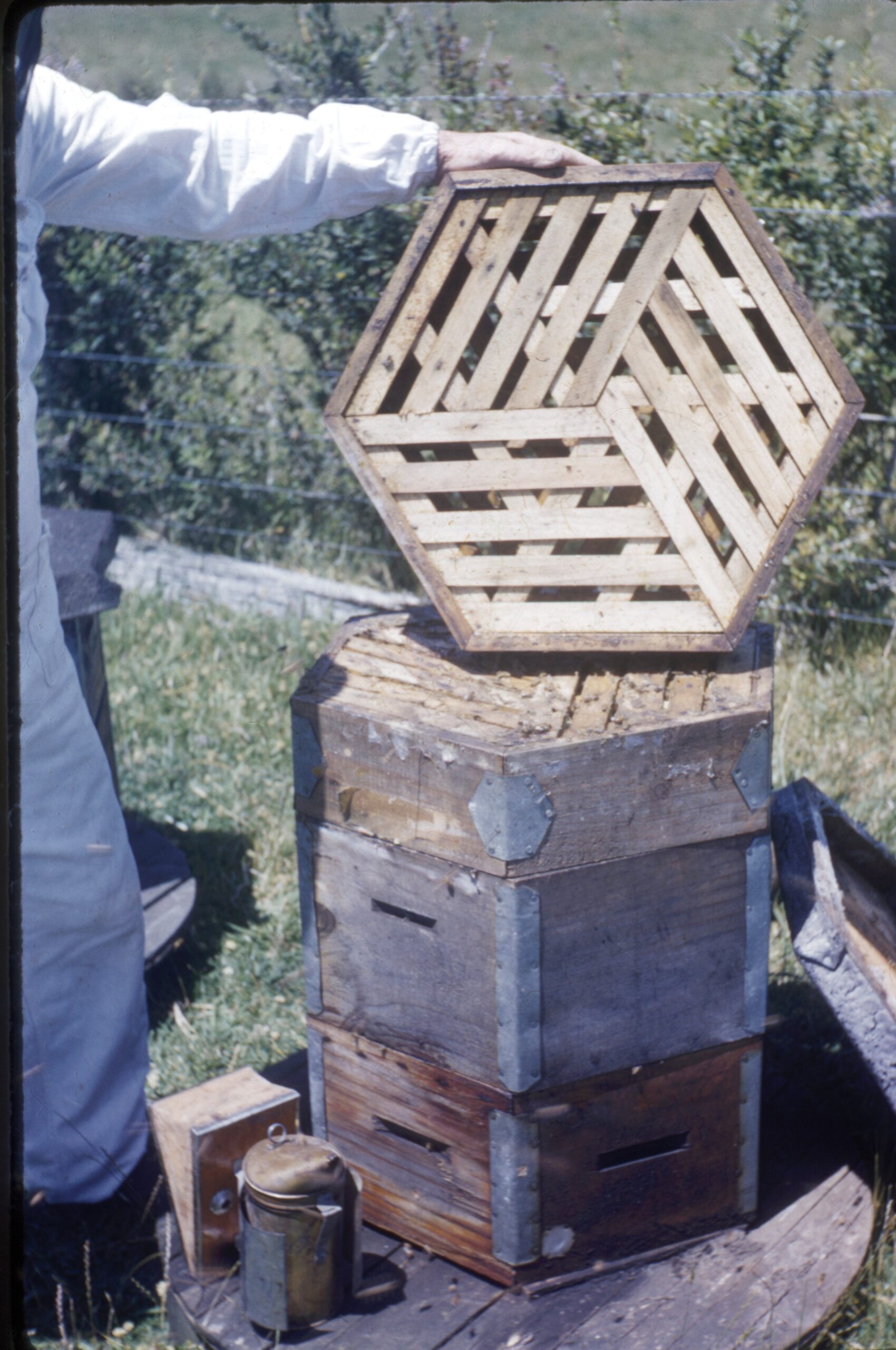
From the author: My partner is a third cousin to John and Peter Berry, grandsons of Percy Berry. Her grandmother was a first cousin of Beatrice Berry (nee Larsen), Percy Berry’s wife. That fact was an absolute delight to discover, and I’m only sorry I never got to talk about it with either Percy or Ian!
https://www.beekeeping.nz/NZBDA/NZBkpr/1986_12_NZBkpr.pdf#page=6
On the face of it, this story just sounds like an innovative beekeeper, one that came up with a new way to deal with some problem honeys. But you don’t have to dig very deep to reveal the differences in marketing philosophies, the personalities and the divisions that were present within the industry. Ultimately, there’s probably more story here about how opposition to the HMA eventually led to its demise some years later.
The HMA and the Regulation of Honey Exports
The Honey Marketing Authority had the sole right to export honey from its start in 1954. But the HMA never regulated the export of comb honey, only extracted honey (and not honeydew, either, but that’s another story). The industry and the HMA had hopes that some of the manuka honey being produced could be marketed as comb honey in this way. It must be remembered that manuka was a problem honey, with difficult extraction and low returns that dragged down the overall returns to HMA suppliers.
Manuka honey’s jelly-like consistency was matched by another NZ honey – ling heather honey, produced late in the season on the Volcanic Plateau. Ling heather honey matched manuka honey well, in both thixotropicity and a strong flavour. They were both, for the most part, considered as “problem honeys”.
From Comb Honey to Cut Comb Honey
So the HMA left the producers of comb honey to find their own export markets (though the HMA did help in developing packaging that would be robust enough to get the comb honey unharmed to the UK). The introduction of “cut comb” honey, with the (now) well-known plastic container with a clear lid, must have been something of a challenge to the HMA. It certainly opened up the potential for more private exporting of honey, but still the volumes were relatively small compared to bulk honey production. The HMA chose its battle to be opposition to the export of bulk honey, especially, and only slowly relenting to allow private exports of packed lines.
The Kimpton’s Agreement
Underlying the “HMA is the only one allowed to export honey (apart from comb honey)” was another marketing feature of the time. The HMA had a long-standing relationship and agreement with Kimptons, a large UK food processor. Kimptons, using its Red Carnation food distributorship, was given the sole rights to sell NZ honey, bulk and packed, in the UK in its marketing territories (most of the rest of the world). One requirement of the Kimpton Agreement was that the HMA was obliged, as much as it could, to discourage any private exports by anyone other than the HMA.
Industry Division
The industry was well and truly divided as to the value of the HMA to the industry as a whole. Producers who supplied honey to the HMA would obviously support the HMA. Beekeepers like Russell Poole, Harry Cloake, Jack Fraser, Kevin Ecroyd, Fred Bartrum and Dudley Lorimer were wholeheartedly supportive of the powers and operations of the HMA. Some, like Jim Barber, were supportive of the HMA, but also backed positions taken by some of the HMA’s detractors. Finally, there were those who opposed the HMA, full stop. Percy Berry would be one of those, along with such as Michael Stuckey, Billy Bray and his son Jasper Bray, and Frank Holt and his son Lloyd Holt, Ray Robinson, Bill Ashcroft, Darrell Carey – there was a wide and consistent opposition to the HMA’s role in the honey industry by many.
But it was Percy Berry who seemed to create the most turmoil – and he did it by standing for the HMA. Through the years the HMA was dominated by suppliers. When Percy Berry stood, effectively as a Seals Levy payer rather than a supplier of honey, it caused a lot of consternation. It was clear that Berry was determined to remove the HMA itself as a factor in the marketing of NZ honey, or at least relegate it to a co-equal position when it comes to regulation and licensing.
Percy Berry Takes on the HMA
Percy was first elected to the HMA in August 1963.
Though vocal and persuasive Berry did not initially pose a real problem to the HMA. The board consisted of five people – four producer representatives and one Government appointee. So during Berry’s first four year stint on the HMA he was out-voted by three others, including such as George Gumbrell, Jack Fraser, Dudley Lorimer – all strongly ‘in favour’ of the HMA. And that last fifth vote of the Government representative, Eric Lee (Dept of Agriculture, in fact), did not ever much come into play. Three HMA stalwarts could vote down any of Percy Berry’s proposals even without the Government’s vote.
And in August 1966 Berry lost his position on the HMA to Harry Cloake.
https://www.beekeeping.nz/NZBDA/timeline/1966_08_HMA_election_Berry.pdf
https://www.beekeeping.nz/NZBDA/timeline/1966_08_HMA_election_material.pdf
The Bale Report
In the lead up to the 1967 elections for the HMA Percy Berry led the charge… He commissioned a report, a discussion paper, through Massey University. The author was Malcolm Bale, who later became well-known for his work with the World Bank, as the Manager of Strategy and Policy for the East Asia and Pacific Region. It was a remarkable piece of work, and Arataki Honey paid to have it sent out widely to all beekeepers.
https://www.beekeeping.nz/NZBDA/timeline/1967_08_Marketing_of_NZ_Honey.pdf
Arataki Honey funded the work which had been previously proposed as a thesis topic. The Bale Report came out just as the HMA elections were ready to begin. There was massive concern about the timing and the contents of the report.
Inside the HMA the General Manager Colin Gosse prepared a confidential report to the HMA members. He didn’t pull any punches in discussing topics or personalities.
https://www.beekeeping.nz/NZBDA/timeline/1967_08_Commentary_on_Bale_report.pdf
The election was dominated by commentary on the Bale Report. Jack Fraser and Dudley Lorimer, both strong HMA advocates, felt compelled to downplay the significance of the Bale Report’s findings, and were often reduced to nitpicking and claims of conspiracies.
https://www.beekeeping.nz/NZBDA/timeline/1967_09_HMA_Elections.pdf
The election results saw both Fraser and Lorimer returned to the HMA. Percy Berry would continue to stand for the HMA, but was defeated several times through the late 1960’s and early 1970’s
Still Pushing for Private Exports
In July 1968 Ian Berry wrote a letter to the NZ Beekeeper magazine, extolling the potential advantages of allowing exporting by NZ’s packers. He specifically mentioned packed lines of ling heather as an opportunity.
https://www.beekeeping.nz/NZBDA/NZBkpr/1968_08_NZBkpr.pdf#page=42
But it wasn’t until August 1969 that the next HMA election saw Harry Cloake returned and Russell Poole elected (with the moderate Jim Barber losing out in the election). Poole would take over from Jack Fraser as Chairman a year later. He would be significant in HMA affairs for nearly 10 years.
Crushed Comb Heather Honey to the UK
But things were happening outside of the HMA. In July 1970 Ian Berry wrote a letter to the magazine noting that Arataki Honey had sent 6 tons of crushed ling heather comb honey to the UK. Ian said that the honey was “very well received” and the buyer expressed an interest in a further 40 tons next season.
https://www.beekeeping.nz/NZBDA/NZBkpr/1970_08_NZBkpr.pdf#page=44
That must have caused a lot of concern for the HMA. The export of honey in this manner must have challenged the HMA’s perception of control of exports. Yes, they had allowed exports of comb honey, and cut comb honey – but those consignments were considerably smaller than what Arataki Honey had exported. And their worries may have extended to the idea that large quantities of honey could be exported in this way – and then further processed at the destination. And that would completely circumvent the controls over export that the HMA claimed!
Russell Poole’s Opposition to the Exports
HMA Chairman Russell Poole must have made some comments along those lines when he drafted his first HMA Annual Report in late 1970. The Government representative, Eric Lee, wrote to him “suggesting” that the Annual Report is not the place for such “controversial” issues.
https://www.beekeeping.nz/NZBDA/timeline/1970_12_Lee_to_Poole_re_annual_report.pdf
Poole would have removed the offending controversy, but still referred to the HMA’s actions to try to placate the proponents of private exports. He described how the HMA had approved shipments of up to 1 ton of packed honey by private packers – but only if the Government imposed an export levy payable to the HMA. The Government did not do that, and no exports were allowed, but the Annual Report still reveals that the HMA was under fire on several fronts.
https://www.beekeeping.nz/NZBDA/HMA_annual_reports/1970_08_HMA_annual_report.pdf
Percy Berry did not relent – he continued his opposition to the HMA in general, and to the Kimpton’s Agreement in particular.
https://www.beekeeping.nz/NZBDA/timeline/1971_05_Berry_calls_for_end_to_HMA.pdf
HMA Chairman Russell Poole responded, defending the use of Kimpton’s, and hoping to explain away the conflicts of interest that Percy Berry had raised regarding Kimptons.
https://www.beekeeping.nz/NZBDA/timeline/1971_06_Poole_re_Kimptons.pdf
Yet Another Shipment of Crushed Comb Exported
But it was clear that there were things happening behind the scenes, too. Arataki Honey was wanting to carry through with an even bigger export of “crushed comb”, this time both manuka and ling heather. Russell Poole tried to give Bob MacDonald, General Manager of the HMA, reasons for the HMA to reject the shipment. Even though the crushed combs were already in export drums, Poole said that it could, and should, still be further processed here in NZ. He queried the levels of manuka and ling heather in the shipment, and wondered if Colin Rope, the Department of Agriculture Honey Taster might be willing to weigh in on the matter.
https://www.beekeeping.nz/NZBDA/timeline/1971_06_Poole_re_crushed_comb_exports.pdf
Not long after that, a short article in the NZ Beekeeper magazine said that Scottish beekeepers were warned they would have to be on their mettle to compete with the NZ ling heather than had been imported the previous season.
https://www.beekeeping.nz/NZBDA/NZBkpr/1971_08_NZBkpr.pdf#page=30
Arataki Honey Loses in Court
It would seem that Arataki Honey exported 14 tons of crushed comb honey in 44 gallon drums at the end of the 1970/71 season. That figure comes from the court case that the HMA took against Arataki Honey in May 1972. The HMA (represented by Russell Poole, Bob MacDonald and someone from the Comptroller of Customs) appeared to charge that Arataki Honey did not have “requisite permit from the appropriate Authority”. The Court found in favour of the HMA, but did not impose a financial penalty on Arataki Honey (the preference of the HMA). But did make Arataki Honey costs of $160 to the HMA.
https://www.beekeeping.nz/NZBDA/NZBkpr/1972_05_NZBkpr.pdf#page=30
Was that the end of it all? Certainly not, if you’re talking about Percy Berry’s attempts to overturn the HMA. It wasn’t until the end of the 1970’s that HMA opponents really showed their electoral prowess. Both Percy Berry and Michael Stuckey were elected to the HMA. And that meant that the balance was now equal between the HMA supporters and the opponents. And it meant a whole new importance to the vote of the Government representative.
Russell Poole Makes One Final Jab at Percy Berry
Percy did have one more wrangle with the HMA. In September 1978 both Percy Berry (by this time a producer representative on the HMA) and Curtis Wicht (HMA General Manager) were reprimanded for their actions relating to some discounting of export honey by Arataki Honey.
https://beekeeping.nz/NZBDA/NZBkpr/1978_09_NZBkpr.pdf#page=11
The NZ Beekeeper concluded –
“The censure motion is one of a number of recent moves involving splits on the HMA board which have created acrimony and ill will among producer members. These have gone so far as to include threats of legal action. With two current members in favour of liberalised private exporting and two in favour of restricted private exporting, the weight of decision on the board is being carried by the government appointee, Mr Hayman.”
With the election of Jasper Bray, an HMA opponent, to the HMA board in August 1978, joining Percy Berry and Michael Stuckey, one might have thought the HMA’s demise was inevitable. When Jasper Bray voted with Ivan Dickinson, and were joined by Don Hayman (the Government representative) things got quite messy and confusing in late 1980.
But the HMA was on the way out, regardless.